

Contact
SCDES Modeling Section
Gregory Quina, Modeling Section Manager - (803) 898-4074
Ozone is a highly reactive, colorless gas pollutant that is not typically emitted directly into the air by any one source. Instead, ozone is considered a secondary pollutant, which means that it is formed through complex chemical reactions of molecules in the air. Specifically, ground-level ozone is formed when nitrogen oxides (NOx) and volatile organic compounds (VOCs) chemically react in the presence of sunlight. While ozone high up in the atmosphere protects us from harmful ultraviolet rays, exposure to high concentrations of ground-level ozone can be quite harmful to our health and environment. That is why we say ozone is “good up high, but bad nearby”.
High concentrations of ground-level ozone can create breathing problems, especially for children, people with asthma or other respiratory problems, and adults who work or exercise outdoors. According to the U.S. Environmental Protection Agency, ozone can also cause tree and crop damage. Mobile sources of air pollution such as cars, trucks, and lawn equipment, contribute to nearly half of the ozone formed in South Carolina.
High ozone concentrations generally occur on hot, sunny days in the spring and summer when the air is stagnant, and the sun’s rays shine more directly on the earth’s surface. Like the weather, ozone and its precursor pollutants can be transported from place to place by wind, resulting in significant changes in ozone concentrations from day to day and even hour to hour.
Ozone is a molecule made up of three oxygen atoms, often referenced as O3. Ozone is formed when heat and sunlight cause chemical reactions between oxides of nitrogen (NOX ) and Volatile Organic Compounds (VOC), which are also known as Hydrocarbons. This reaction can occur both near the ground and high in the atmosphere.
Just remember that ozone is "Good Up High, Bad Nearby."
Stratospheric ozone is good ozone. It forms about 10-30 miles above the Earth's surface and forms a protective layer, called the ozone layer, that shields us from too much of the sun's harmful ultraviolet radiation (UV).
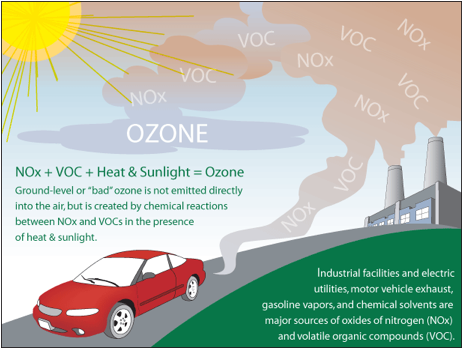
Ground-level ozone is bad ozone. Ozone harms human health and the environment when it forms close to the ground. The most significant things that cause ground-level ozone to form are:
We see higher ground-level ozone amounts most often in summer, due to increased amounts of UV radiation during the longer days, but ozone can still form in spring, fall, and even winter given the right conditions.
Even though the emission sources that contribute to ground-level ozone are typically found in urban areas, strong winds can also move it into rural areas, causing them to have high amounts of ground-level ozone.
People with respiratory conditions such as asthma, or those who are active outside on days when ozone amounts are high can feel shortness of breath, wheezing, and coughing. We can all take actions to help protect ourselves and reduce the damaging effects of this pollutant on our health and environment.
SCDES meteorologists provide next-day ground-level ozone forecasts from March 31st to September 30th to allow the public to be proactive about protecting their health by reducing outdoor activities and by reducing their own contributions to emissions when ozone concentrations are expected to be high. If ozone levels are forecast to reach unhealthy levels (exceeding the ozone National Ambient Air Quality Standard), SCDES will declare an 'ozone action day' advising people to reduce their activity levels outdoors, especially for those with respiratory conditions, such as asthma. Historical monitoring data indicates that unhealthy ozone concentrations are extremely rare during fall and winter months due to beneficial weather conditions and the lower sun angle that typically keeps ozone concentrations lower than in spring and summer months. Since the vast majority of days in March and October exhibit “code green” ozone concentrations (i.e., low concentrations similar to other fall and winter months), forecasters currently do not issue daily ozone forecasts for these two ozone monitoring season months. Forecasters keep an eye on ozone observations and weather conditions each day during these two months and issue an 'ozone action day' in the rare event that is necessary. Additionally, historical monitoring data shows that ozone forecasts are not necessary in the Coastal Plain region of South Carolina outside of the Charleston area (shown by the “no forecast” white area on the ozone forecast map) due to lower emissions and more favorable weather conditions for cleaning the atmosphere of ozone precursor pollutants at locations closer to the coast.

Ways to get the South Carolina ozone forecast:
Other Ozone Forecasts
Don't live in South Carolina? Here are some useful links to find the ozone forecast in other areas:
SCDES Modeling Section
Gregory Quina, Modeling Section Manager - (803) 898-4074