

 Water quality standards protect and restore the quality of our surface waters in accordance with the Clean Water Act (CWA). The CWA is the primary Federal statute regulating the protection of the nation’s water. The CWA aims to prevent, reduce, and eliminate pollution in the nation's water to "restore and maintain the chemical, physical, and biological integrity of the Nation's waters," as described in CWA section 101(a). Water quality standards define the goals for a waterbody by designating its uses, setting criteria to protect those uses, and establishing provisions to protect water quality from pollutants. The South Carolina Department of Environmental Services works with the U.S. Environmental Protection Agency (EPA) to revise existing standards and create new standards based on changing water quality conditions, changing waterbody uses, and new scientific information on the effects of pollutants in the environment.
Water quality standards establish the foundation on which other programs work to achieve and maintain protective water quality conditions, such as:
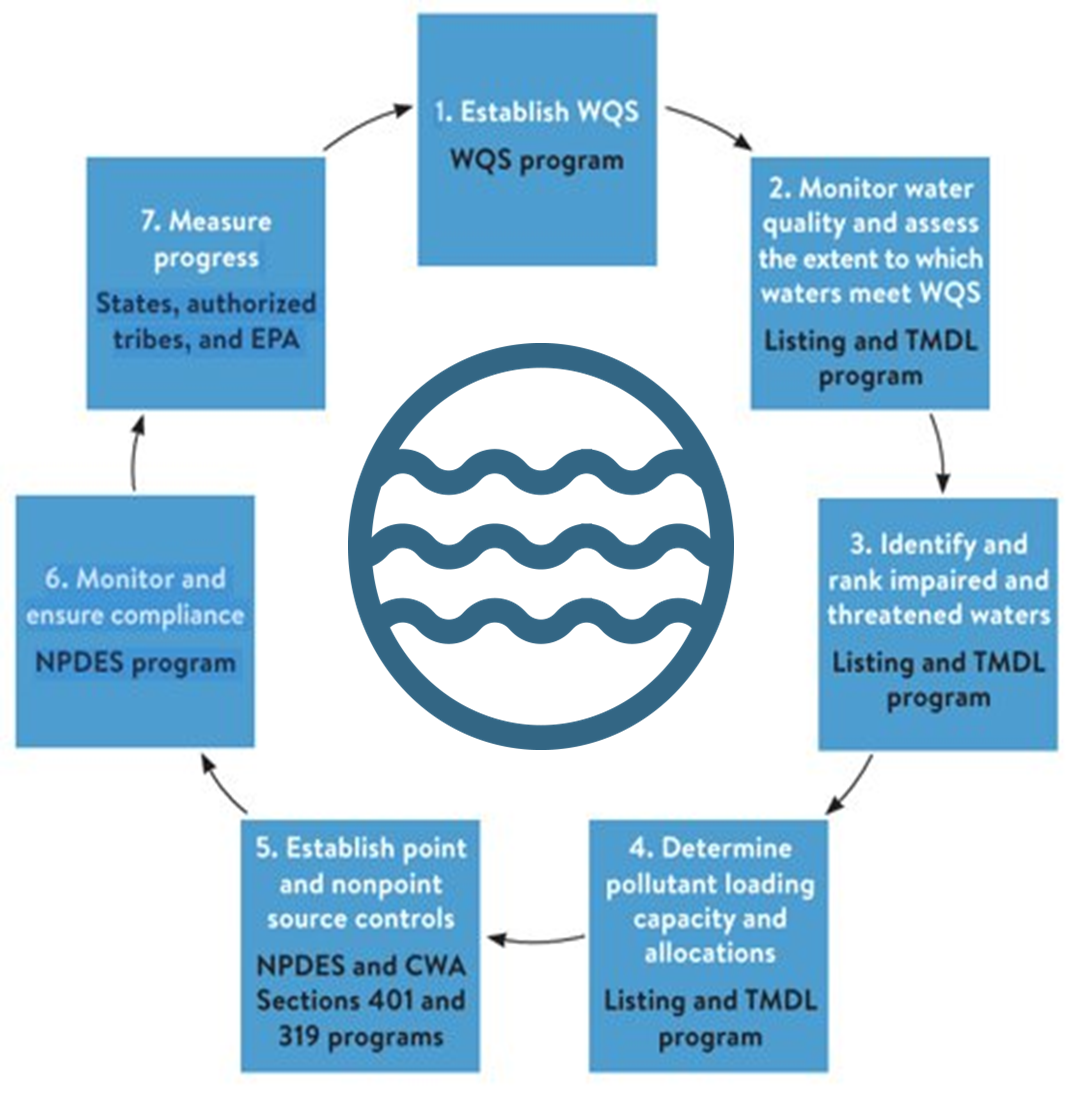
- Total maximum daily loads (TMDLs)
- Waste load allocations (WLAs) for point source dischargers
- Load allocations (LAs) for non-point source dischargers
- Water quality management plans
- Effluent limits for NPDES permits
- Water quality certifications under Section 401 of the CWA
- State of South Carolina Integrated Report (i.e. 303(d) list and 305(b) report)
- Section 319 non-point source pollution grants
The three core components of water quality standards are designated uses, water quality criteria, and antidegradation requirements. Additional components of water quality standards may include general policies, variances, provisions authorizing the use of compliance schedules in permits.
 South Carolina's water quality standards are promulgated in S.C. Regulation 61-68, Water Classifications and Standards (R.61-68). This regulation sets forth the classifications of our state's waters and establishes water quality standards that protect and maintain the existing and classified uses of those waters. Those beneficial uses, criteria set to protect and maintain those uses, and our antidegradation policy are all required components of the water quality standards as set forth in the CWA.
S.C. Regulation 61-69, Classified Waters (R.61-69), is a compilation of many of the waters of the State listed by name, the county(ies) where the waterbody is located, the classification of the waterbody, any designation for that waterbody, and a brief description of the waterbody including any site-specific numeric criteria that apply to the listed waterbody. R.61-69 must be amended each time a waterbody is reclassified to another classification. To ensure consistency between the state's regulations, R.61-69 must also be amended if changes are made to the classification systems found in R.61-68. All waters of the state of South Carolina are classified even if they are not specifically named or listed in R.61-69. For those waters not specifically listed in R.61-69, the classification of the waterbody that they are tributary to is the assigned class for those waters pursuant to the rules in both R.61-68 and R.61-69.
Section 303(c)(2)(B) of the CWA requires that South Carolina's water quality standards be reviewed and revised, where necessary, at least once every three years for the purposes of considering the Environmental Protection Agency's most recent numeric and narrative criteria and complying with recent Federal regulatory revisions and recommendations. This process is known as the triennial review. Regulations to be reviewed during the triennial review include R61-68 and R.61-69. Topics that are typically considered during each triennial review include, but are not limited to:
- Review and, where appropriate, adoption of revised federal water quality criteria to reflect the most current final published criteria according to Sections 304(a) and 307(a) of the CWA.
- Addition or revision of definitions.
- Stylistic changes which may include corrections for: readability, grammar, punctuation, typography, codification, references, and language style.
- Additional topics are addressed during the triennial review process as needed.
Details of past rulemakings are provided below.
Promulgation Process Updates
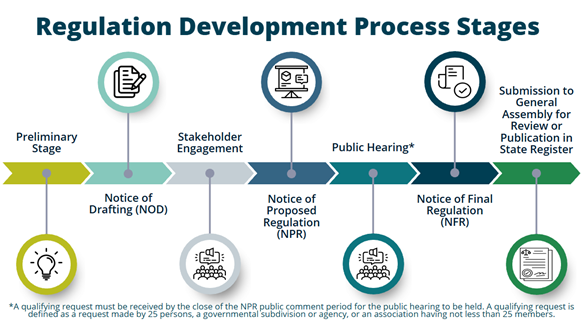
This triennial review will follow a similar promulgation schedule as previous reviews. However, on May 19, 2023, Governor McMaster signed 2023 S.C. Act 60 (Act), restructuring the South Carolina Department of Health and Environmental Control (DHEC). Pursuant to that legislation, DHEC and the DHEC Board were abolished, and South Carolina Department of Environmental Services (SCDES or Department) was created, effective July 1, 2024. Pursuant to S.C. Code Ann. Section 48-6-20(A) and Section 14(B) of the Act, SCDES is vested with all the functions, powers, and duties of the environmental divisions, offices, and programs of DHEC including the power and duty to promulgate associated regulations. Therefore, some changes to the promulgation process are necessary.
The preliminary stage consists of Department staff planning and preparation for the upcoming promulgation process. The Notice of Drafting officially kickstarts the rulemaking process, which will be immediately followed by a thirty-day public comment period. Stakeholder engagement provides multiple opportunities for the public to engage Department staff with questions or comments regarding regulation development. The Notice of Proposed Regulation reveals the Department’s proposed regulatory revisions to the public. This is typically followed by further stakeholder engagement and another opportunity for the public to ask questions or provide comments. The public hearing will take place either before the Administrative Law Court or at SCDES to meet the requirements of CWA Section 303(c) and 40 CFR 131.20. The Notice of Final Regulation shows the final version of the regulation once the Department has considered all comments received from stakeholders. The regulation is then delivered to the General Assembly for Legislative Review. Once approved by the General Assembly, the Department submits the final version of the regulation to EPA for review. If EPA chooses to approve the revisions, then the new or revised water quality standards may be used for purposes under the CWA.
EPA Triennial Kickoff
EPA provided several recommendations for the Department to consider during the triennial review in a letter sent on February 26, 2026.
EPA's 2026 Triennial Review Kickoff Letter
Notice of Drafting
The Notice of Drafting for the 2026 triennial review of R. 61-68 and R. 61-69 was published in the State Register on Friday, February 27, 2026. The public comment period opened on February 27th and will close on March 30th. Please submit any comments to Andrew Edwards at Bureau of Water, South Carolina Department of Environmental Services, 2600 Bull Street, Columbia, S.C. 29201 or wqs@des.sc.gov. To be considered during this triennial review, the Department must receive comments no later than 5:00 p.m. on March 30, 2026.
Notice of Drafting (2-27-2026)
The Department received the following comments in response to the Notice of Drafting:
- SCWQA Comments (5-2-2025)
- SCWQA Comments (6-24-2025)
- ONRW Reclassification Request for Portions of AICW (12-22-2025)
- Waccamaw Riverkeeper Comments (1-20-2026)
- Black-Sampit Riverkeeper Comments (1-22-2026)
- SCMC Comments (1-22-2026)
- SCWQA Comments (2-27-2026)
- SCMC Comments (3-24-2026)
- SCPA Comments (3-27-2026)
- Ethan Ware Comments (3-30-2026)
- SCRF Comments (3-30-2026)
The Department offers the following summary response to comments:
Summary of Public Comments and Department Responses
Water Quality Standards Rule
EPA’s Water Quality Standards Regulatory Revisions were finalized in August 2015. The following document provides a summary of these revisions and describes how the final rule affects the 2026 Triennial Review.
EPA’s 2015 Water Quality Standards Regulatory Revisions
Stakeholder Meetings
The Department is hosting two stakeholder meetings to discuss the Notice of Drafting and to receive stakeholder input regarding water quality standards issues and potential revisions to R.61-68 and R.61-69.
Stakeholder Meeting #1
- Tuesday April 28, 2026, 10:30 - 11:30 am
Microsoft Teams Virtual Meeting
Please contact wqs@des.sc.gov for meeting access information. - Meeting #1 Presentation
Stakeholder Meeting #2
- Tuesday May 12, 2026, 10:30 - 11:30 am
Linton Room (4011)
2600 Bull Street
Columbia, SC 29201 - Meeting #2 Presentation
Stakeholder Meeting #3
- Tuesday October 20, 2026, 2:00 - 3:00 pm
Microsoft Teams Virtual Meeting
Please contact wqs@des.sc.gov for meeting access information. - Meeting #3 Presentation
Proposed Regulation
The Notice of Proposed Regulation was published in the State Register on September 25, 2026. An official public comment period began once the notice was published and will last through October 26, 2026. Please submit any comments related to the Notice of Proposed Regulation to wqs@des.sc.gov prior to the close of the comment period.
Notice of Proposed Regulation (9-25-2026)
The proposed amendments to R.61-68, which the Department is considering include:
- the addition of a definition for naturally variable parameters
- the revision of the definition for natural conditions
- the addition of narrative hydrologic criteria
- the removal of biological assessment language
- the revision of bacteria permitting requirements for POTWs
- the revision of stormwater permitting compliance requirements
- the clarification of hardness used for permitting hardness dependent metals
- the clarification of how designated uses are applied to unnamed tributaries
- technical corrections related to significant digits throughout
The proposed amendments to R.61-69, which the Department is considering include:
- the correction of the waterbody description for Bear Creek
- the correction of the waterbody name for Edisto River
- the correction of the waterbody name for Gaffney Creek
- the addition of Great Swamp in Jasper County
- the correction of the waterbody classification for New River
- the deletion of one instance of Santee River, which was listed multiple times
- the correction of the waterbody name for Stoop Creek
- the correction of the waterbody name and description for Town Creek
- the deletion of one instance of unnamed creek, which was listed multiple times
- technical corrections related to significant digits throughout
The Department received the following comments in response to the Notice of Proposed Regulation:
- SCWQA Comments (9-29-2026)
- Ken Koth Comments (10-5-2026)
- SCWQA Comments (10-13-2026)
- SCWQA Comments (10-20-2026)
- SCWQA Comments (10-21-2026)
- NCASI Comments (10-23-2026)
- SCMC Comments (10-23-2026)
- BioCleaner USA Comments (10-25-2026)
- SCRF Comments (10-26-2026)
- HBASC Comments (10-26-2026)
- K.C. Price Comments (10-26-2026)
- SCWQA Comments (10-26-2026) (1)
- SCWQA Comments (10-26-2026) (2)
Public Hearing
The Department is hosting a public hearing to inform stakeholders about the triennial review process and the scope of proposed revisions to water quality standards. The hearing will be held on December 1, 2026, at 10:00 am in Peeples Auditorium located at 2600 Bull Street, Columbia, SC 29201. The Department is planning to provide a virtual option to join the public hearing and will provide details for joining the hearing virtually at least two weeks prior to the scheduled hearing. During the public hearing, there will be a time provided for questions and answers. However, because the hearing will serve as the last opportunity to provide comments on the proposed revisions to R.61-68 and R.61-69, the Department will set aside most of the hearing to receive comments from stakeholders. The Department asks that any new comments made during the public hearing also be submitted in writing to wqs@des.sc.gov at the conclusion of the hearing. Any comments previously submitted during the 2026 triennial review process, either in response to the Notice of Drafting or the Notice of Proposed Regulation, do not need to be submitted during the hearing because they are already included in the triennial review record.
 EPA has produced guidance in the form of a four-part test to answer the question of what makes a new or revised water quality standard.
- Department staff prepared a strategy to pursue the adoption of numeric nutrient criteria for all surface waters of the state in 2004. The plan has since been revised in 2006, 2010, 2014, and 2021. EPA has reviewed the Department’s most recently updated strategy and granted mutual agreement with the plan.
- Department staff worked alongside staff from EPA and Georgia EPD to develop a strategy for adopting numeric nutrient criteria in the state’s estuaries.
- One core component of the Department’s water quality standards is the antidegradation policy. This policy establishes the decision-making procedures which the Department follows to determine whether lowering the existing water quality is warranted and appropriate.
- A section of the Department’s antidegradation policy describes naturally low dissolved oxygen waterbodies. The Department has established a dissolved oxygen methodology to determine whether to allow a de minimis deficit in waters not meeting numerical standards due to natural conditions.