

Visit the S.C. Beach Access Guide and zoom in or select a beach to look for swim advisory spots in that area. 

BEACH ACCESS GUIDE

Beach Monitoring Advisories 

Any active, short-term swim advisories, will appear in the table below. If it is empty, there are no current short-term advisories. 

AdvisoryBeachLocationStation


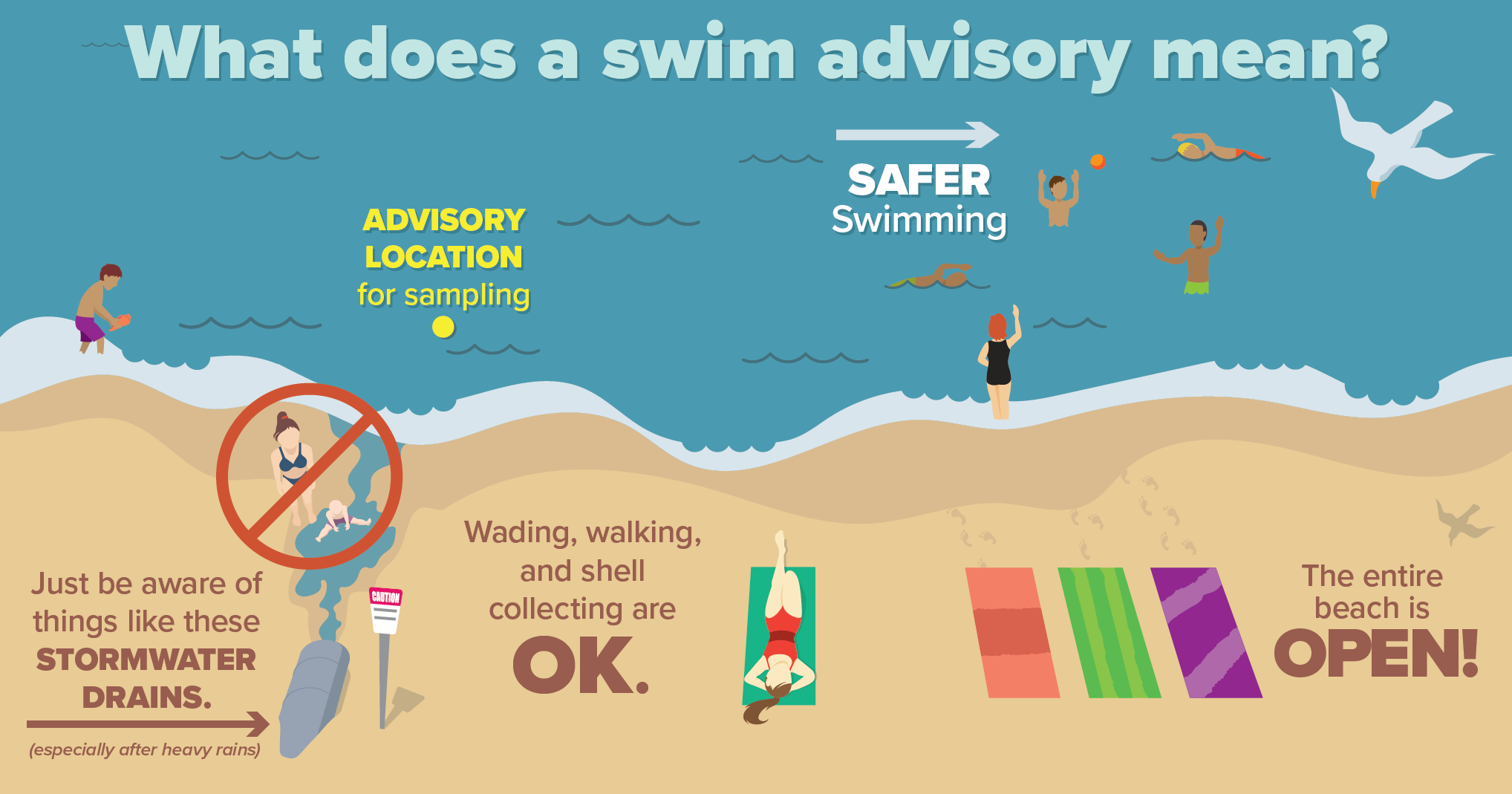
SCDES routinely collects water samples at more than 120 locations along South Carolina's beaches. If high numbers of bacteria are found, we issue an advisory for that portion of the beach. An advisory means that SCDES advises you NOT to swim in those areas. This is especially true for young children, the elderly, and those with compromised immune systems.

Advisories do not mean that the beach is closed. Wading, fishing, and shell collecting do not pose a risk. Advisories may be issued due to high bacteria counts or rainfall. Advisories are lifted when sample results fall below the limit of 104CFU/100mL. 

We recommend all beachgoers check our Beach Monitoring data for the latest information before going to their favorite beach destination, to learn more about any short-term or long-term swim advisories. While SCDES's Beach Monitoring Program monitors for levels of certain bacteria, it's important to remember that natural waterbodies aren’t chemically treated like swimming pools, so there is always a risk of coming into contact with potentially harmful bacteria, viruses, other organisms or contaminants. Learn about the potential risks of recreating in ambient water at des.sc.gov/safeswimming.

Frequently Asked Questions about Beach Water Monitoring and Swimming Advisories

Enterococcus bacteria are tested in the samples to indicate presence of bacteria in the water. Elevated levels of these bacteria in the water can indicate possible contamination by fecal waste. Enterococcus is a type of bacteria that lives in the intestinal tracts of warm-blooded animals, including humans, pets and wildlife. Enterococci are typically not considered harmful to humans, but their presence in the environment may indicate that other disease-causing organisms may be present.

While SCDES monitors for levels of enterococci, it's important to remember that natural waterbodies like the ocean aren’t chemically treated like swimming pools, so there is always a risk of coming into contact with potentially harmful bacteria, viruses, other organisms or contaminants. Learn about the potential risks of creating in ambient water at des.sc.gov/safeswimming. General recommendations include:

  • Don't enter the water with open sores or lesions. Different pathogens exist naturally in oceanwater that can cause infection by entering the body through open wounds. 
     
  • Don't swim or allow children to play in swashes or near stormwater pipes. Although the shallow pools of water on the beach caused by swashes and stormwater seem like good places for children to play, these shallow pools are caused by runoff and can contain much higher levels of bacteria or contaminants than the ocean.

SCDES issues short-term or temporary swimming advisories during the swimming season from May 1 to October 1. 

Short-term (or temporary) advisories typically last one to two days. Long-term swimming advisories (see description below) are issued for beach water monitoring locations that have an increased possibility of high bacteria levels -- especially following rain events -- due to stormwater runoff.

Beach swim advisories are for isolated spots at monitoring locations where swimming is not advised. Most swim advisories are temporary, lasting only a day or two. 

While SCDES's Beach Monitoring Program monitors for levels of certain bacteria, it's important to remember that natural waterbodies aren’t chemically treated like swimming pools, so there is always a risk of coming into contact with potentially harmful bacteria, viruses, other organisms or contaminants. Learn about the potential risks of creating in ambient water at des.sc.gov/safeswimming.

SCDES has partnered with several municipalities, counties and other stakeholders to develop Check My Beach, a website that provides important information about beach safety. This includes information on rip currents, flag safety and water quality. It also links to local area beaches for specific beach information. SCDES plans to expand Check My Beach beyond the Grand Strand area and add more partners along the coast. 

As a reminder, swimming in the ocean or one of South Carolina’s lakes and rivers is a great way to cool off during the hot summer months, but outdoor activities in a natural waterbody can pose some risks to people's health, so it’s important to be aware of steps you can take to protect yourself and others when recreating in ambient water. Learn more at des.sc.gov/safeswimming. 

 A short-term advisory is issued (at sites that don't already have a long-term advisory in place) when a sample exceeds the accepted standard of 104 MPN/100mL over two consecutive days, or, if the first sample exceeds the accepted standard when a potential source of bacteria is nearby, such as a stormwater drain. If any single routine sample exceeds 500 MPN/100mL, a temporary advisory is immediately issued.   

Follow-up sampling is performed daily, and the temporary advisory is removed when the enterococcus bacteria levels drop below the standard.

SCDES places temporary signs at sampling points on the beach and our S.C. Beach Guide is updated to show the temporary advisory. There is also a beach advisory table at the top of this webpage that updates with temporary advisories. For beaches not yet taking part in the Check My Beach program, a press release is sent to local news outlets (print, TV and radio) when a short-term advisory is issued and when it is lifted.

A long-term advisory is issued for monitoring locations where more than 10% of the data collected over the past five years exceeds the recreational use standard for enterococcus. The need for a long-term advisory at a monitoring location is reassessed each year. Temporary advisories are not posted where long-term advisories already exist.

Signs posted at these locations provide recommendations in the immediate area due to the potential of high bacteria levels, usually associated with rainfall events. The long-term advisories and signs typically are located where stormwater from pipes or swashes (small creeks) flows across the beach to the ocean.

Long-term advisories began in Myrtle Beach in 2007 and in Surfside Beach and Horry County in 2008.

Coastal Carolina University collects data at several stations in the Grand Strand area and reports the results to SCDES year-round for informational purposes. 

Temporary swimming advisories are not issued outside of the May 1 to October 1 monitoring season.

Yes. Stormwater solutions and improvements that are implemented by local governments are working, resulting in a downward trend in the number of long-term advisory signs.  Signs for a long-term advisory are removed when water quality data shows improvement (less than 10% of the samples exceed the standard). 

There are 122 beach water monitoring stations in the state, located from Cherry Grove Beach near the South Carolina-North Carolina border to the southern end of Hilton Head Island. SCDES samples water at the state's beaches twice a month from May 1 to October 1. Beaches in the Myrtle Beach area are sampled weekly.

Swimming in the ocean or one of South Carolina’s lakes and rivers is a great way to cool off during the hot summer months. However, outdoor activities in a natural waterbody can pose some risks, so it’s important to be aware of steps you can take to protect yourself and others.  

Natural waterbodies aren’t chemically treated like swimming pools, so there is always a risk of coming into contact with potentially harmful bacteria, viruses, other organisms or contaminants. The health effects from exposure to these bacteria, organisms and contaminants can vary greatly. 

Before enjoying a day in the sand, we recommend beachgoers make themselves aware of certain information and conditions, including:

  • whether lifeguards are on duty
  • rip current safety
  • weather forecasts and tidal cycles
  • local beach ordinances and rules
  • any nearby long-term or short-term swimming advisories

CheckMyBeach.com is an excellent source of information for beaches along the Grand Strand. SCDES’s Beach Monitoring webpage is another important tool for checking long-term and short-term swim advisories.  

SCDES monitors ocean water at 122 collection points along the coast during the busy summer months, and if certain bacteria levels are too high, the agency issues a short- or long-term swim advisory to help protect people from potential health impacts. A swimming advisory doesn’t mean a beach is closed — if a swimming advisory is in place, you should avoid swimming in the water at the collection point until the advisory is lifted.

Other ways to safe and healthy at the beach:

  • Be aware of advisories and avoid swimming in those areas. Wading, fishing and shell collecting don't present a risk since most exposures to pathogens occur by swallowing water. 
     
  • Don't enter the water with open sores or lesions. Different pathogens exist naturally in oceanwater that can cause infection by entering the body through open wounds. 
     
  • Don't swim or allow children to play in swashes or near stormwater pipes. Although the shallow pools of water on the beach caused by swashes and stormwater seem like good places for children to play, these shallow pools are caused by runoff from paved surfaces and often contain much higher levels of bacteria than the ocean.
     
  • Don't swim in the ocean or in the river during or immediately following rainfall. To further reduce risk of illness, wait at least 48 hours after a heavy rain to resume swimming. Heavy rain can wash bacteria and possibly harmful pathogens into the surf. High bacteria densities persist in the surf for hours after these rains and may increase swimmer's risk of illness. 

Learn more about the possible risks of recreating in natural waterbodies like the ocean, lakes and river at des.sc.gov/safeswimming.
 

*A short-term advisory is issued at sites that do not already have a long-term advisory in place when a sample exceeds 104 MPN/100mL over two consecutive days, or, if the first sample exceeds the standard when a potential source of bacteria is nearby, such as a stormwater drain. Also, if any single routine sample exceeds 500 MPN/100mL, a temporary advisory is immediately issued.   

Tags
Career of Service
Bureau of Coastal Management