This webpage provides information about current and historic environmental clean-up efforts that SCDES was involved in around the state. This information helps provide information to affected communities, and the information about a specific clean-up is updated regularly until the remediation efforts are thoroughly completed. For information about any environmental clean-up in your area, contact SCDES at info@des.sc.gov or (803) 898-3432.

*Updated Aug. 21, 2026 

S.C. Department of Environmental Services (SCDES) is continuing to coordinate with U.S. EPA Region 4, the S.C. Department of Agriculture (SCDA) and Fairfield County officials on the environmental clean-up efforts of the fire at the Healthcare SC facility in Winnsboro, S.C. The top priority of all responding agencies is to continue to mitigate any potential impacts to people or the environment.

U.S. EPA Region 4, SCDES, SCDA, and Fairfield County will continue to work together on a unified response and remediation to this facility fire in the best interest of protecting people, property and the environment. The agencies will continue to provide updates. Local residents can continue to contact their Fairfield County Public Information Office at gene.stephens@fairfield.sc.gov. Residents are encouraged to follow information issued by government agencies or trusted news sources. 

Background

Fairfield County Fire Service and First Responders responded to a fire alarm the morning of Aug. 16, 2026, at the Healthcare SC facility on Hwy 321 S. in Winnsboro, S.C. Fairfield County Emergency Officials remained the lead authority throughout the response. In these types of instances, local officials remain the lead authority and SCDES Emergency Response Team personnel respond when requested to provide advisory assistance. 

Local officials requested SCDES presence in the early morning hours of Aug. 17 to support the efforts of Fairfield County officials and the many entities helping to respond to this fire. Fairfield County officials and partner entities performed a thorough, collaborative response to this fire, and they are continuing to keep local media and the public updated of the latest happenings.

U.S. EPA Region 4 also responded to the site and assisted in air monitoring and the monitoring of stormwater runoff from the firefighting water being applied to the site.

Healthcare SC hired an emergency environmental clean-up contractor to bring large vacuum trucks and temporary storage tanks onsite for removal of water runoff and have constructed a temporary dam to further contain runoff.

Aug. 21, 2026 Update

Preliminary data collected during and after the fire do not indicate harmful impacts to air or drinking water in the community.  

SCDES continues to monitor potential water runoff impacts from the site. Healthcare SC hired an environmental clean-up contractor to bring large vacuum trucks and temporary storage tanks onsite for removal of water runoff and have constructed a temporary dam to further contain runoff. SCDES meteorologists forecasted rain in the area, so preparations have been made to collect additional runoff generated from potential rain. The collected runoff will be safely disposed of.

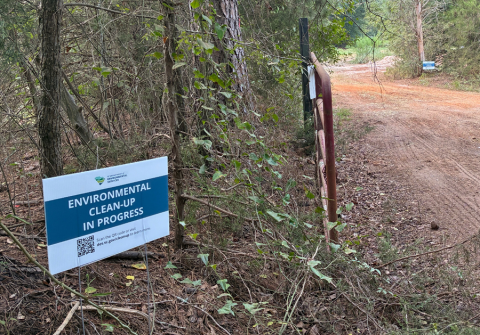
SCDES has been working directly with nearby property owners to keep them informed of steps taken to minimize runoff impacts and to provide any recommendations. SCDES has posted “Environmental Clean-up" signage in areas where remediation efforts are ongoing. 


SCDES also is working closely with Fairfield County and the Town of Winnsboro (the public drinking water utility that serves the community). Public drinking water is monitored continually for compliance with state and federal drinking water standards, and there have been no readings indicating impacts to drinking water provided to customers. There are no anticipated impacts to private drinking wells.

SCDA has been in direct communication with the produce farmers in the surrounding area to address individual concerns about potential impacts to crops from debris or water runoff from the facility fire. SCDA officials are providing specific information to these property owners based on their vicinity to the site and other factors.  

*Updated June 10, 2026

SCDES is coordinating with EPA Region 4, the Products (SE) Pipe Line facility (a subsidiary of Kinder Morgan), and local officials on the ongoing remediation of a diesel fuel release in Spartanburg. 

The leak was quickly stopped by the facility, and the facility issued proper notification to both SCDES and EPA Region 4. The number one priority of the ongoing remediation efforts is to limit impacts of the diesel fuel to people and the environment. This webpage will be updated regularly to provide updates to the community.

Details of the Release

On Feb. 1, 2026, SCDES’s Division of Environmental Emergency Response received a report from the National Response Center about a release of diesel fuel at the Products (SE) Pipe Line Corporation in Spartanburg. The diesel fuel leaked into a catch basin designed to contain potential releases. Some of the discharge flowed out of the catch basin and into nearby Four Mile Branch Creek before the outfall of the catch basin was closed.

Upon notification of the diesel release, SCDES immediately responded by sending Emergency Response personnel to the site to observe the incident and advise the facility on best mitigation efforts for minimizing impacts to the environment. In these types of incidents, SCDES doesn’t perform the actual clean-up but provides a technical assistance role.  

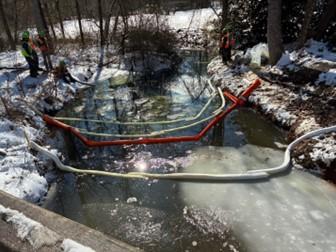
Products (SE) Pipe Line had quickly set up absorbent booms in multiple locations along Four Mile Branch Creek to contain the diesel. The facility also contacted multiple environmental cleanup contractors that responded and used vacuum trucks to remove the diesel from the site of the release, then moved on to other areas where diesel was observed. Air monitoring is being conducted for worker and public safety as the clean-up continues. 

EPA Region 4 personnel also responded to the scene to coordinate on mitigation efforts. SCDES and EPA entered into Unified Command with Kinder Morgan, which is standard environmental response and remediation protocol. The facility has provided this fact sheet about the release: Incident Information Fact Sheet

Image removed.Booms were quickly deployed to help contain the diesel in Four Mile Branch Creek. 

Remediation and Next Steps

Once the visible diesel is removed, soil removal and excavation will begin in areas impacted by the release. The extent of the soil removal will be determined by removing visually stained soils. Once the removal is complete, the facility will collect soil samples that will be sent for laboratory analysis to confirm that impacted areas have been properly remediated. If the laboratory data indicate the presence of diesel fuel, then remediation activities may continue.

  • FEB. 19 UPDATE: During a site visit on Feb. 18, SCDES field staff did not observe sheen or product residue in the creek or nearby. Response crews have completed removal of impacted or possibly impacted foliage and limbs. The facility is moving forward with collecting water samples and pond sediment samples for testing to assess for any impacts from the diesel release; those sample results will be shared with SCDES. Remediation efforts by the response crews hired by the facility have been thorough.
     
  • FEB. 10 UPDATE: Response crews have begun removal of oiled vegetation and clearing obstructions from the creek to promote flow of oil and emulsion to the established collection points. Crews continue to remove oil, oil-water mix and debris from the creek. SCDES and EPA’s Federal On-Scene Coordinator (FOSC) confirmed the outfall location where the oil entered the creek had been successfully cleared, and low-pressure flushing operations were properly performed to remove oil from a concrete channel, riprap and gravel. The outfall pipe from the catch basin was opened and vacuumed. SCDES will continue oversight of cleanup of this release, including thorough site monitoring walk-throughs.   
  • MARCH 8 UPDATE: Excavations to remove impacted soils and materials were completed at the release area and spillway area prior to the intersection with Four Mile Branch. Soil samples were collected from the release area excavation and analyzed for petroleum hydrocarbons and volatile organic compounds. Additional source removal, including debris and vegetation removal along the creek and petroleum contact water (PCW) and diesel fuel recovery from onsite infrastructure and various locations along the creek, was also completed. Recovery efforts for PCW and diesel fuel completed between February 2 and 18th collected approximately 124,800 gallons of PCW and approximately 20,200 gallons of diesel.

    The emergency response phase was completed and the site transitioned to an operation and maintenance phase on February 17th with approval of SCDES and EPA. Operation and maintenance activities for the release are ongoing and are expected to continue until regulatory requirements are met. This phase includes regularly scheduled visual observations, boom maintenance, and soil and water sampling at locations along the creek. Containment booms have been in place along the creek since the release; the booms continue to be regularly monitored for collection of petroleum product, sheen, and debris, evaluated for efficiency and integrity, and replaced as need.  
  • JUNE 9 UPDATE: During a site visit from SCDES and EPA staff on May 29th, no petroleum product or sheen was evident at the initial release entry point of Four Mile Branch or at the final containment booms placed at the creek bridge at Four Mile Branch Rd. After several months of monitoring, it was determined by EPA, SCDES, and Products (SE) Pipe Line personnel that the booms are no longer necessary and are ready to begin phased removal. For the next monitoring period, booms will remain in place at a midpoint and an endpoint location at the creek bridge at Four Mile Branch Rd for continued monitoring. Sediment and surface water samples will be collected and analyzed for petroleum hydrocarbons and volatile organic compounds in June; results will be reported to SCDES.