

The South Carolina Public Service Authority (Santee Cooper) and Dominion Energy South Carolina (Dominion) are seeking environmental permits from SCDES to construct and operate an Advanced Class Combined-Cycle turbine generating plant at Canadys Station (Plant or Project) in Colleton County.  The primary fuel source for the turbines as proposed will be natural gas, with No. 2 fuel oil l as a secondary fuel, when needed.  

SCDES will be reviewing applications submitted by Santee Cooper and Dominion (collectively Applicants) for the Project.  As applications are received, SCDES will review detailed reports, studies, modeling, and engineered designs based on state and federal environmental laws and regulations for program areas including air quality, coastal zone consistency, groundwater withdrawals, wastewater, and stormwater. For a project the scale and scope of the proposed plant at Canadys Station, permit applications are not typically submitted at the same time.  

The following applications have been submitted and are currently undergoing review:  

  • Application seeking coverage under the NPDES General Permit for Stormwater Discharges from Construction Activity for clearing portions of the site, along with a request for Coastal Zone Consistency Certification for this application. There is no proposed filling or clearing of Waters of the State associated with these submissions. (HQP-74Z5-SG94S & HQP-BQ22-XKTG7)
  • Application seeking a permit to withdraw Groundwater (HQM-ADFN-VDZ9A)
  • Application for an air quality Prevention of Significant Deterioration (PSD) construction permit (HQK-VNVB-V6Z7V)

Additionally, a related project is anticipated which would supply natural gas via a proposed pipeline (Bridge Project). Applications for the Bridge Project will be submitted separately by Elba Express Company, a subsidiary of Kinder Morgan, representing Applicants Dominion and Santee Cooper. No applications have been submitted to SCDES for the pipeline at this time.  

This webpage has been developed by SCDES as a community resource and will be updated as new information is made available. Please bring this webpage to the attention of others you know who may be interested.

Canadys Station Site

The Canadys Station Site previously operated as a coal-fired power plant by South Carolina Electric and Gas (SCE&G) and later its successor Dominion from 1962 to 2013.  Since 2013, activities at this site have been focused on demolition and decommissioning of the coal-fired power plant and ancillary facilities.  This site has continued utility operations as an energy corridor with existing 110 kilovolt transmission lines, a substation and other related infrastructure.  
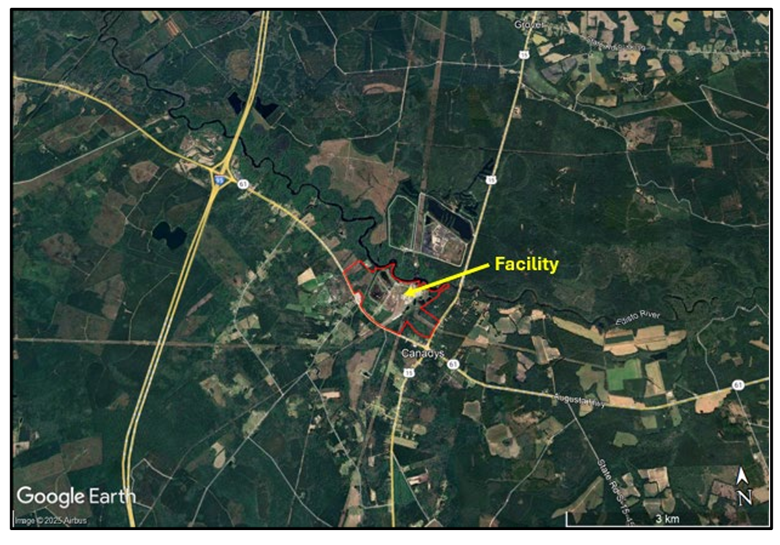
Satellite map showing a rural area with roads, fields, and forested land. A yellow arrow labeled “Facility” points to a site outlined in red near the community of Canays. Major highways and the Edisto River are visible in the surrounding landscape.
Figure 1: The Canadys Station is located in Colleton County, west of the intersection of Augusta Highway, (SC Highway 61) and Jefferies Highway (US Highway 15). 


SCDES’s Bureau of Air Quality issues air quality permits that limit the amount of regulated air pollutants emitted at a facility. Air construction permits are issued to a facility to specify what conditions must be met to demonstrate compliance with state and federal air quality regulations and standards. These air quality regulations and standards are established to be protective of public health and the environment.

Summary of Application Under Review 

The Project as proposed is designed to generate a net electrical output of approximately 2,200 megawatts (MW). The Project includes the installation of three (3), independent, advanced-class, multi-shaft, one-on-one (1x1) combined cycle combustion turbine (CCCT) power trains. Each power train will include a combustion turbine-generator, a heat recovery steam generator equipped with supplementary firing (duct burners), and a steam turbine-generator. The application also includes ancillary equipment required to operate an electrical generating plant such as: gas fired auxiliary boiler, diesel fired emergency generators, fuel storage tanks, gas supply equipment, and cooling towers.

Santee Cooper and Dominion have applied to obtain a Prevention of Significant Deterioration (PSD) construction permit. A PSD is designed to:

  • protect public health and welfare;
  • preserve, protect, and enhance the air quality in national parks, national wilderness areas, national monuments, national seashores, and other areas of special national or regional natural, recreational, scenic, or historic value;
  • assure that any decision to permit increased air pollution in any area to which this section applies is made only after careful evaluation of all the consequences of such a decision and after adequate procedural opportunities for informed public participation in the decision-making process.

The application includes supporting data and ambient air impact analysis.The application was received on April 24, 2026, and deemed technically complete on May 24, 2026. The application is currently under technical review by the SCDES Bureau of Air Quality. The technical review includes reviewing emission calculations, performing a regulatory review, review of the proposed BACT, conducting an ambient air quality analysis, and verifying that the proposed project can meet all applicable air quality regulations if constructed and operated as proposed in the air permit application. A copy of the application was also provided to the US EPA and the Fish and Wildlife Service (Federal Land Manager for Cape Romain Class I).  

A copy of the application may be obtained here.
Add link to the application
Add link to the Modeling files

Status – General Timeline

•    Application received – April 24, 2026
•    Application Deemed Technically Complete –May 24, 2026
•    Application is under technical review

Next Steps

  • Begin Drafting the Preliminary Determination, Statement of Basis and PSD Construction permit
  • Public Notice the completed Draft Permit and supporting documentation for a minimum of 30 days
  • Hold joint availability session/public meeting with ? to answer questions related to the project
  • Hold Public Hearing to receive verbal comments on the Draft Permit, hearing will be held no earlier than 30 days after public notice.
  • Review all comments written and verbal received on the Draft Permit and prepare a response to comments.
  • Issue a final permit decision


SCDES’s Bureau of Coastal Management implements the South Carolina Coastal Zone Management Program (SC CZMP) in the eight coastal counties. The SC CZMP seeks to achieve balance between the appropriate use, development, and conservation of coastal resources in the best interest of all citizens of the state through management of natural, historical and cultural resources. The Canadys Station is located in Colleton County and is subject to the SC CZMP program policies. 

Coastal Zone Consistency (CZC) reviews are conducted for projects and applications based on State and Federal laws. CZCs are not stand-alone decisions of the department. The coastal zone consistency is a certification triggered by applications for federal funding, federal agency activities, federal licenses/permits, and state permits.

Summary of Application Under Review 

SCDES is currently reviewing a request for Coastal Zone Consistency certification associated with initial land disturbance activities within upland areas at the DESC Canadys Station facility. The total disturbed area is approximately 107 acres. The proposed land disturbing activities are to support preliminary site construction activities. There are no wetland impacts proposed under this current submission.
Status
HOLD HEARING REFERENCE 
 

In designated capacity use areas of the state’s coastal plain, a permit is required for any groundwater withdrawal in excess of 3 million gallons in any given month. The proposed Canadys Station is located within the Lowcountry Capacity Use Area. Permitted facilities are required to submit an annual report of their use to SCDES.

Summary of Application

SCDES is reviewing a groundwater withdrawal permit application for the installation and operation of four (4) industrial wells to supply a closed-cycle, air-cooled condenser system for cooling and condensing exhausted steam from the facility’s steam turbine-generator to serve the Project. The wells would allow for a maximum of 530 million gallons per year to be pulled from McQueen and/or Charleston aquifers.

The application outlines the proposed facility will utilize air-cooled condensers and dual-fuel, advanced-class combustion turbines for the combined-cycle power blocks. During periods of warm weather, the facility plans to use the secondary (fuel oil) source. This scenario requires an additional water demand beyond the “base” needs for the facility. 

Higher water demands will also occur when the facility is operating on fuel oil, which requires demineralized water/diluent injection for emissions controls to meet air quality permitting standards.  

  • Average Month (natural gas operation only): ~9.75 million gallons per month
  • Peak Month (natural gas operation and fuel oil): ~67.5 million gallons per month 
  • Peak Month (fuel oil operation, w/ no turbine inlet chilling (TIC)): ~75 million gallons per month
  • Peak Month (fuel oil operation, w/ TIC): ~135 million gallons per month

The former Canadys Steam Plant (a coal-fired plant) utilized two cooling water intake structures from the Edisto River. Per Dominion’s application, due to the Edisto River being high in concentrations of organic matter and other dissolved contaminants, the quality is insufficient for the advanced systems being put in place for the proposed natural gas facility. Surface water from the Edisto River would require extensive treatment before utilization by the plant.
Status 

Currently, the groundwater capacity use application has undergone Department review and public notice. Comments received during the public notice period are being reviewed and a response to those comments is forthcoming.
 

The National Pollutant Discharge Elimination System (NPDES) is a federal program created in 1972 under the Clean Water Act to regulate the discharge of pollutants to waterways from regulated sources. Stormwater discharges from Canadys site will be regulated both during construction as Construction Site Stormwater Runoff and will continue to need a permit under the NPDES Industrial Stormwater Permit once it goes into operation. 

Construction Stormwater

To perform clearing and grading of the Canadys site, the Applicants must apply for an NPDES stormwater permit.

To seek coverage under the NPDES General Permit, applicants must engage professional engineers to prepare a Stormwater Pollution Prevention Plan (SWPPP), a site-specific document or collection of documents that identifies the potential sources of stormwater pollution, describes stormwater control measures, such as Best Management Practices (BMPs), to reduce or eliminate the identified pollutants. The SWPPP identifies procedures operators will implement to comply with specific permit conditions.

Summary of Application

Applicants routinely submit more than one application seeking an NPDES stormwater permit for a project the scale and scope of the proposed Canadys project.

Per discussions with Dominion Energy and Santee Cooper, SCDES is expecting separate applications for the various areas of this project. Each submission will be individually reviewed by Stormwater Permitting as the project progresses forward to include all land disturbances on site.

SCDES is currently reviewing an application for clearing, grading, and excavating of upland area totaling 107 acres to develop a future administrative campus, energy infrastructure, operational areas, and construction staging areas. Proposed construction consists of clearing and grubbing of existing land, grading of existing contours, construction of stormwater detention basins, and paving operational areas of the proposed facility. These land disturbance activities are to support preliminary site construction activities; there are no wetland impacts in this area of initial disturbance. 

The Stormwater Permitting Section will be reviewing the project SWPPP, engineering report, and proposed site plan to include detention structures for compliance with the Construction General Permit. 

Industrial Stormwater

Prior to the start of any industrial activity at the facility, an Industrial Stormwater Notice of Intent under Permit number SCR000000 should be submitted for any industrial stormwater outfalls not covered under a separate NPDES permit. The facility would be required to adhere to the Industrial Stormwater General Permit SCR000000, including maintaining a Stormwater Pollution Prevention Plan (SWPPP) onsite, as well as any monitoring required by Sector O based on the facility’s industrial activity. Effluent limit guidelines associated with Sector O requirements only apply to steam electric generating facilities with coal storage piles.

NPDES discharge permits for wastewater are intended to protect water quality and public health by setting limits on what can be discharged and requiring compliance monitoring. SCDES has been delegated to implement the NPDES permitting program on behalf of EPA in the state. The proposed Canadys NGCC project will require an individual NPDES permit tailored to the facility. NPDES Permits establish pollutant limits to ensure discharges do not harm the receiving waterways. They also require:

  • Monitoring and reporting
  • Compliance with treatment technologies
  • Public participation in the permitting process including opportunities for comments

To date, the applicant has not yet submitted a wastewater permit application for the proposed Canadys NGCC facility. A formal application is not anticipated until early 2027.
 

Section 401 and 404 permits are complementary regulatory tools under the Clean Water Act, with 401 focusing on state water quality certification and 404 regulating dredge and fill activities in Waters of the United States. Section 404 of the Clean Water Act regulates the discharge of dredged or fill material into waters of the United States, including wetlands, streams, lakes, ponds, etc. The U.S. Army Corps of Engineers (USACE) administers the permit program. Regulated activities may include:

  • Depositing fill, dredged, or excavated material into waters
  • Grading or mechanized clearing of wetlands

Section 401 requires states to certify that a federally permitted activity complies with the state’s water quality standards. Projects, such as Canadys Station, which may need a 404 permit must also obtain a 401 Water Quality Certification from SCDES.  

The first step to determining if a water feature is subject to state and federal rules under section 404/401 is for a professional to evaluate the limits of waters of the U.S. Applicants will often request USACE issue a Jurisdictional Determination (JD) to demonstrate their concurrence with the evaluation. The Applicants are still working through the process of assessing and coordinating with USACE for a JD.