

Updated Aug. 25, 2026
Valara Holdings High Performance Compute Center (also referred to as "Valara" or by its parent company, "NorthMark Strategies") is a data center located in Spartanburg, S.C. The facility is required to receive certain environmental permits from the S.C. Department of Environmental Services (SCDES) before it can begin operations, in addition to other local and state permits from other entities.
This webpage has been developed by SCDES as a community resource and will be updated as new information is available. Please bring this webpage to the attention of others who may be interested.
June 25 Public Meeting/Hearing
A public hearing for a draft Synthetic Minor Air Construction Permit (CP-50000422) for Valara Holdings High Performance Compute Center (also referred to by its parent company, NorthMark Strategies) was held Thursday, June 25, 2026, at 6:45 p.m. at Spartanburg Memorial Auditorium. An availability session was held prior, from 5:30-6:30 p.m.
With the significant community interest in this draft permit, SCDES has extended the public comment period to July 31, 2026. The permit application remains under review and there is no time frame as to when a decision about the permit may be made.
All of the comments SCDES receives during a public comment period are reviewed and considered by our permitting staff before a permit decision is made. A written response to the comments received will be provided along with the permit decision.
Informational materials presented at the June 25 public hearing are available here:
- Submitting public comments handout
- Fact sheet
- Facility map 1
- Facility map 2
- Air modeling information
- Air modeling analysis
Current Draft Air Permit
On March 4, 2026, Valara submitted an application to SCDES for a second Synthetic Minor Air Construction Permit. The facility is requesting to generate additional onsite electricity using 11 natural gas-fired turbines, and to operate in compliance with new emission limits.
After receiving and reviewing the permit application and supplemental data and reports, SCDES permitting staff wrote a draft permit and draft statement of basis that are currently available for public review and comment.
The public comment period for this Synthetic Minor Air Construction Permit began May 26, 2026, and has been extended to July 31, 2026.
The public can submit comments multiple ways:
- Submit a comment online
- Send a comment by postal mail to SCDES Bureau of Air Quality, Air Permitting Division Director, 2600 Bull Street, Columbia SC 29201
- Email a comment to AirPNComments@des.sc.gov
Those wishing to be notified directly by SCDES when a permit decision is made can sign up by emailing SCDES at AirPNComments@des.sc.gov or ask to be notified via ePermitting.
If issued, this permit would require the facility to construct and operate in compliance with state and federal air quality regulations, just as the first permit also requires.
First Air Permit (2025)
SCDES issued Valara a Synthetic Minor Air Construction Permit (CP-50000316) on Sept. 17, 2025. This permit was for the installation and operation for onsite electricity generated by 24 permanent natural gas─fired 2103 kW generators with selective catalytic reduction and oxidation catalyst air pollution control devices. This air permit also established federally enforceable limits on NOx, CO, VOC, Single HAP and Total Combined HAP.
The public comment period for that draft permit was July 18 to Aug. 16, 2025. After a full permit application review and consideration of public comments received, SCDES issued the Synthetic Minor Air Construction Permit (CP-50000316) on Sept. 17, 2025.
On April 21, 2026, this permit (CP-50000316) was amended to include 21 temporary natural gas─fired 1500 kW generators. These generators are not allowed to operate when the permanent generators are in operation and cannot remain on site longer than six months.
Air Dispersion Modeling Plots
All AERMOD air dispersion modeling inputs contain maximum allowable emission rates (by pollutant), stack release parameters, five years of hourly National Weather Service weather data, US Geological Survey terrain data, nearby building information, and receptor points (every 50-100 meters) for where calculations will be made. The model contains mathematical formulas that simulate the release and dispersion of pollutants in the atmosphere. After processing the model, the model outputs contain the predicted pollutant concentrations at ground level for each receptor. Output data can be aggregated into different averaging time periods (hourly, daily, annually) based on the health-based standards.
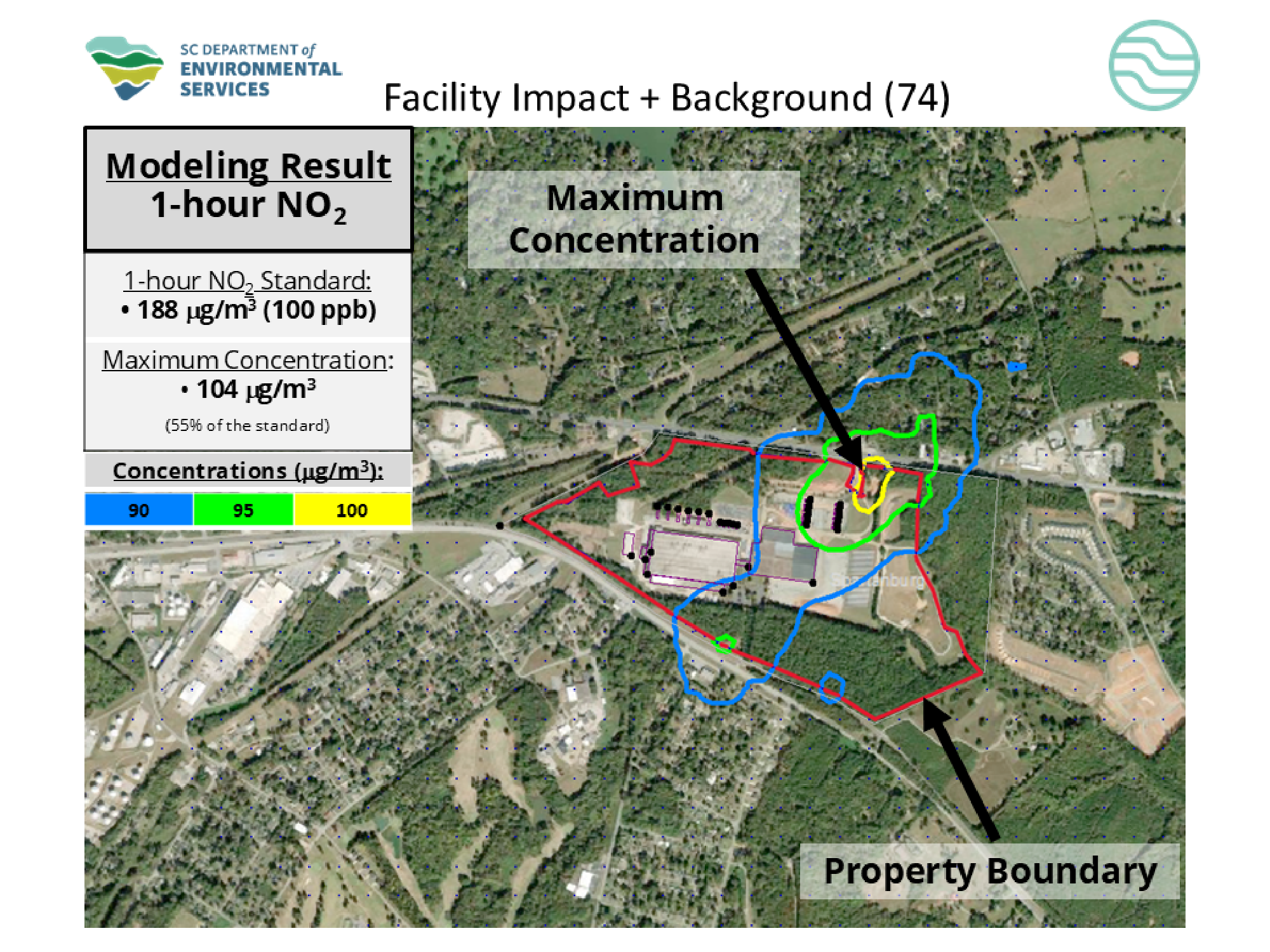
- NO2-1hr Map: The map shows the EPA AERMOD air dispersion model output EPA design value concentrations for the Nitrogen Dioxides (NO2) 1-hour averaging period. The EPA design value concentration is a statistical measure that is consistent with the National Ambient Air Quality Standards (NAAQS). For the NO2 1-hour NAAQS, the design value measure is the five-year average of the eighth-high (98th percentile) 1-hr daily maximum concentrations, and this statistic is used to compare to the health-based EPA standard, which is 188 micrograms per cubic meter. Contours show the facility's impact footprint on the surrounding community. A background concentration value of 74 micrograms per cubic meter has been added. Results show that the highest design value concentration is below the EPA health-based standard.
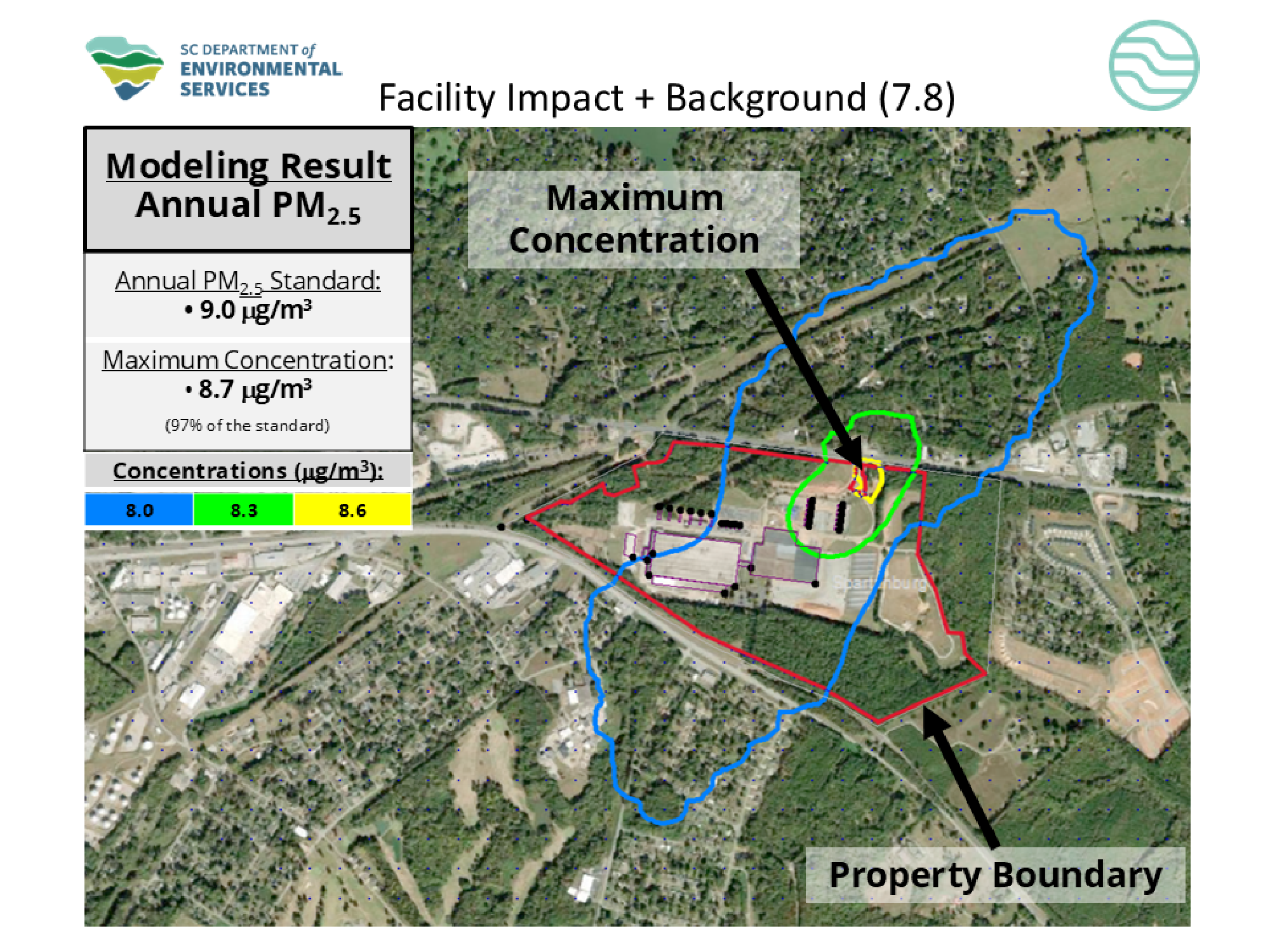
- PM2.5-Annual Map: The map shows the EPA AERMOD air dispersion model output EPA design value concentrations for the Fine Particulates (PM2.5) annual averaging period. The EPA design value concentration is a statistical measure that is consistent with the National Ambient Air Quality Standards (NAAQS). For the PM2.5 annual NAAQS, the design value measure is the five-year average of the annually averaged maximum concentrations, and this statistic is used to compare to the health-based EPA standard, which is 9.0 micrograms per cubic meter. Contours show the facility's impact footprint on the surrounding community. A background concentration value of 7.8 micrograms per cubic meter has been added. Results show that the highest design value concentration is below the EPA health-based standard.
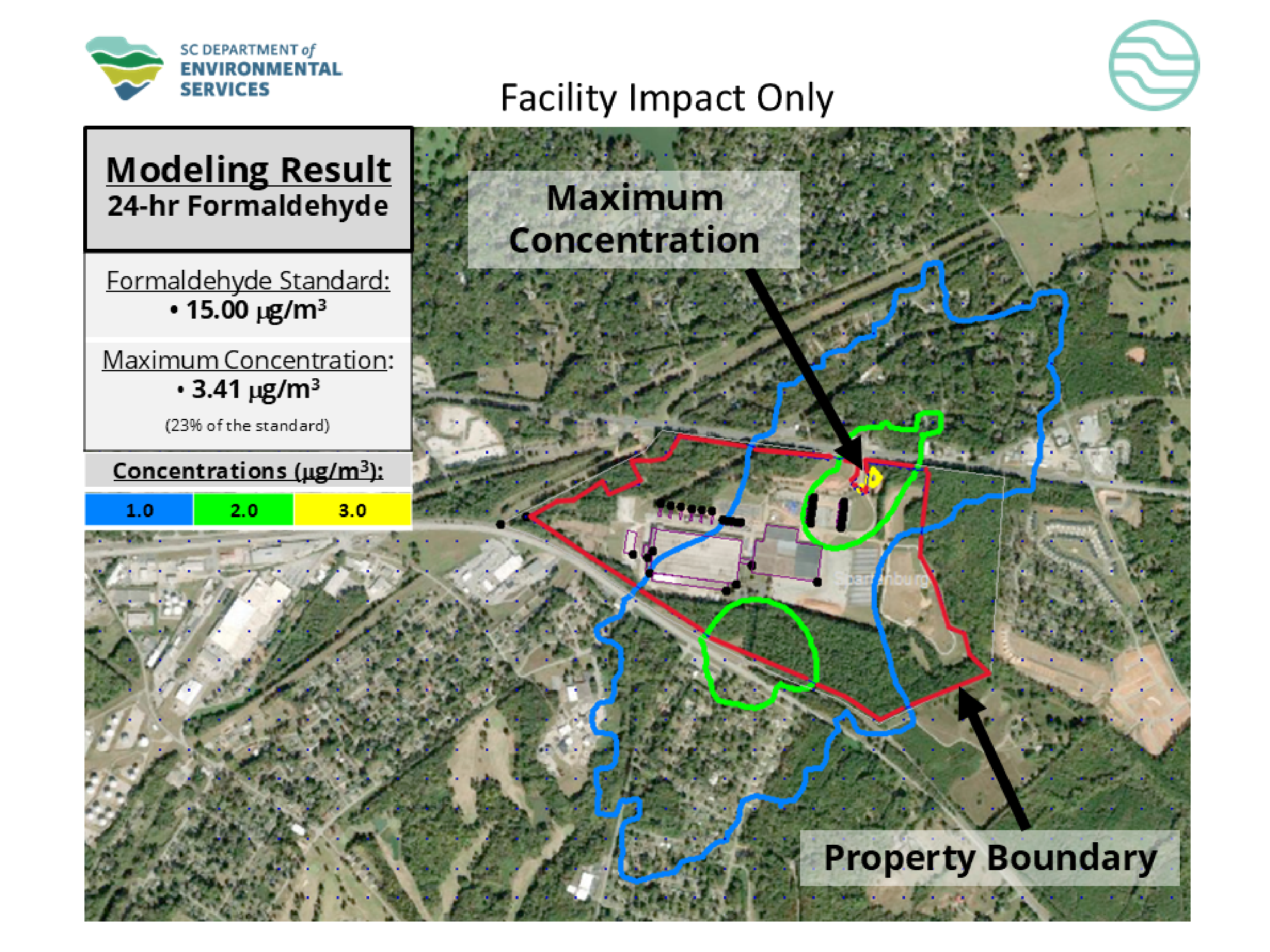
- Formaldehyde Map: The map shows the EPA AERMOD air dispersion model output concentrations for the formaldehyde 24-hour averaging period. The maximum 24-hour concentration is compared to the state regulation, which is set at 15 micrograms per cubic meter. Contours show the facility's impact footprint on the surrounding community. Results show that the highest design value concentration is below the state-set standard. (There are no federal ambient air standards for formaldehyde.)
We will continue to provide updates and information to this webpage (des.sc.gov/valara).