

$2,500 Winners
Allendale Fairfax Middle School, Allendale County
“Cultivating Sustainability Through School Gardening”
Students will design and plant raised garden beds with native plants to create a pollinator habitat. They will practice sustainable gardening techniques including composting and rainwater harvesting. Project partners include Master Gardeners, Allendale County Stormwater Department, and the local 4-H Club. A local native plant nursery will donate plants and help install a wildflower bed, and a local beekeepers’ association will teach the students about the role of bees in pollination and food production.
Blue Ridge High School, Greenville County
“Sustainable Courtyards”
High school students will plan the courtyard garden by mapping different layouts, choosing native plants, and identifying maintenance needs. During installation, students will also prepare reclaimed materials such as lumber, bricks, and metal for use as benches, planters, and decoration. Future Farmers of America, Clemson Extension, and Blue Oak Horticulture will partner on the project and provide expert guidance on native plants and sustainable landscaping.
Conway Elementary School, Horry County
“CES Pollinator Oasis”
Conway Elementary School’s Go Green Club will retrofit a dry stormwater pond to create a native pollinator garden. Students will help design the garden and select plants based on the specific pollinators they want to attract. As they plant and maintain the garden, they will learn about soil health, water quality testing, and pollinator ecology. Project partners include Coastal Carolina University’s Environmental Quality Collaborative, Clemson University, Clemson Extension, and South Carolina Native Plant Society.
Diamond Hill Elementary School, Abbeville County
“Garden Restoration and Expansion”
This project will build upon existing vegetable and herb gardens by adding native and non-native gardens to compare ecological differences between the two. A dedicated butterfly habitat will also be installed. A detailed maintenance schedule for watering and weeding will keep students involved throughout the year and ensure the long-term health of the gardens. This Green Step School will partner with Clemson Extension and South Carolina Governor’s School for Agriculture for guidance about sustainable gardening.
James H. Hendrix Elementary School, Spartanburg County
“HES Community Garden”
Students will add drip irrigation to existing raised beds and use compost to enrich the soil. They will also share stories about how gardens can help connect cultures through newsletters, garden labels, community outreach events, and art displays. Community families and Master Gardeners will be partners on the project.
Leaphart Elementary School, Lexington County
“Seed to Fitness”
Students at this Green Step School will compare production of vegetables grown in both soil and hydroponic gardening systems. They will also study insects, food webs, soil health, erosion prevention, and weather data, and showcase their harvest in a student-led farmers' market. In addition to Green Steps mentors, Clemson Extension, Future Farmers of America, and Master Gardeners will provide guidance on this project.
Lowcountry Montessori School, Beaufort County
“Monarchs and Milkweeds”
After noticing many Monarch butterflies with a protozoan parasite known as Ophryocystis elektroscirrha (OE), the school’s Garden and Ecology Lead resolved to guide students in replacing tropical Milkweed in the school garden with native Milkweed species. In addition to planting and maintaining the garden, students will tag monarchs and study butterflies with OE using a microscope. The South Carolina Wildlife Federation donated milkweed seeds and the Whole Kids foundation Garden Grant provided funding for a greenhouse. This Green Step School will also partner with The Beaufort Conservation District, Camellia Garden Club Beaufort County Public Works, the Beaufort Garden Society, and a local gardener.
Mullins High School, Marion County
“Solar Learning Lab”
Students in Biology 1, Integrated Science, Chemistry, and STEM-focused courses will learn about sustainable energy by measuring how much sunlight the school gets daily, studying how solar panels work, and analyzing real-time data generated from solar panels installed on the outdoor learning lab. They will also help monitor and maintain the solar panels. Clemson Extension and Marion County Soil and Water Conservation District will provide technical support and educate students about the environmental benefits of solar power.
Tall Pines STEM Academy, Aiken County
“Creek Connections”
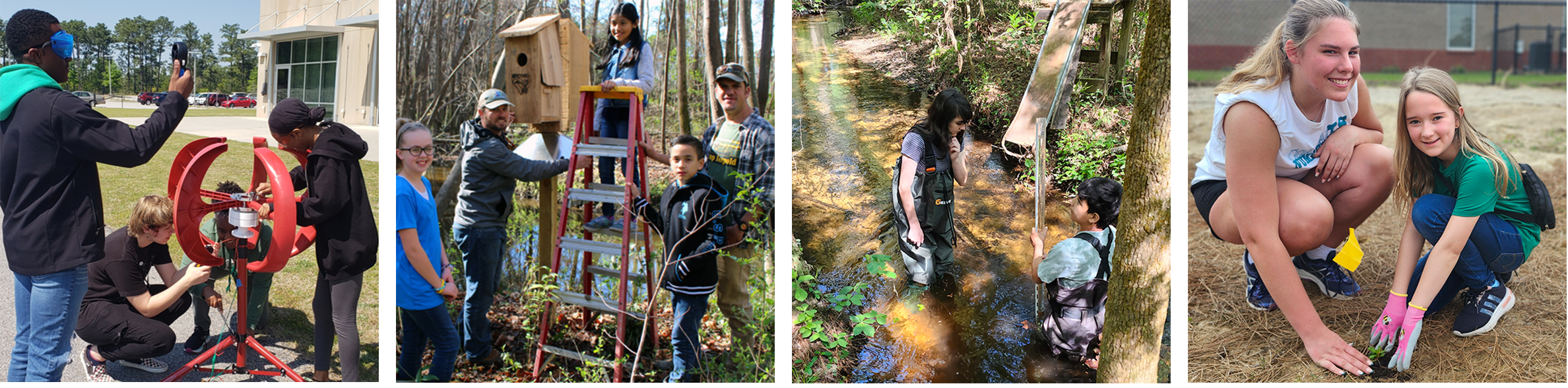
Middle school students at this Green Step School will establish an Adopt-a-Stream club to monitor water quality of a creek adjacent to the school campus. Physical, chemical, and biological data will be recorded and uploaded to the statewide database used by the SC Adopt-a-Stream program. Students will also learn to identify the invertebrates and plant life that indicate healthy water quality, as well as environmental impacts resulting from human activities. In addition to the SC Adopt-a-Stream program, the Clemson University Learning Institute will also be a partner on the project.
Virtus Academy of South Carolina, Florence County
“Ethnobotanical Garden”
Students involved in this project will grow native plants, including those with cultural significance, using sustainable and organic gardening methods. They will learn about the plants’ cultural uses in food and medicine, as well as their ecological importance to pollinators. Clemson Extension, Master Naturalists, the South Carolina Native Plant Society, and Florence County Stormwater staff will provide guidance on native plant selection and sustainable gardening techniques.
$1,500 Winners
Pickens Elementary School, Pickens County
“Restoring Our School Pond”
This project will restore a school pond that once attracted turtles, frogs, dragonflies, and pollinators. Students will remove debris and invasive plants, install native aquatic and shoreline plants, monitor water quality, and identify and record wildlife that visits the pond. The Farm Bureau, Pickens County 4H, and the Pickens County Clemson Extension Water Resource Coordinator will help students maintain the pond, care for wildlife, and test water quality.
South Aiken High School, Aiken County
“The Pollinator Patch”
Students will practice sustainable gardening practices as they install containers around the school with pollinator plants to increase the biodiversity of the schoolyard. Bird baths and bee houses will add to the critical habitat components required by the SC Wildlife Federation to certify South Aiken High School as a schoolyard habitat. Students will also create signage for each container highlighting what plants are growing and which pollinators they attract.
St. Joseph Catholic School, Anderson County
“Butterfly Garden”
Elementary school students will expand the school’s current garden habitat by adding drought tolerant plants that attract native butterflies such as Monarchs and Swallowtails. Students will visit the Butterfly Garden at the Clemson Botanical Garden to learn about the life cycle of butterflies, and they will host a butterfly festival in Spring 2026 for the school and the community. Clemson Extension, Clemson Botanical Garden, Clemson Entomology Department, and Master Gardeners will provide guidance and support on the project.
$2,500 Winners
Charleston Collegiate School, Charleston County
“Bat Habitat Restoration and Enhancement”
Tenth grade students will construct and install bat houses in the school’s Outdoor Education Center and plant flowers that attract pollinators. They will also learn how bats support healthy ecosystems by helping control insect populations.
Clay Hill Elementary School, Dorchester County
“Healthy Eagles”
This hydroponics project will teach students about water conservation, sustainable gardening, and energy efficiency. Students will adjust nutrients and lighting to achieve maximum growth, and they will analyze the data to understand the effectiveness of this gardening method.
Fennell Elementary Magnet School, Hampton County
“Fostering Fennell's Future”
The school’s courtyard will be transformed into an outdoor classroom focused on creating habitat for native plants and animals. Students will install flowers, bat and bird houses, and a smart bird feeder with a camera for up close observation.
Guinyard Butler Middle School, Barnwell County
“Veggie Tales”
By creating a raised garden bed, special education students will learn how to grow and harvest their own vegetables. Connecting with nature will also help them learn self-confidence, experience stress relief, and develop healthy lifestyles.
Pendleton High School; Anderson County
“Container Berry Project”
Students will learn about water conservation and energy efficiency by using a micro drip irrigation system to grow blackberries and blueberries. They will also monitor and adjust nutrients to maximize fruit yield.
The Montessori School of Columbia, Richland County
“Cultivating Education and Sustainability”
This Green Step School will use a hydroponic gardening system to teach students about soil and water conservation. Students will mix nutrient solutions, adjust water levels, and clean the system between plantings.
$1,500 Winners
Andrew Jackson Academy, Bamberg County
“For the Love of Pollinators”
This project will educate first graders about the importance of pollinators. Students will plant and care for flowers, install a bird bath and solar powered fountain, and create a walking path with educational signage.
C.E. Williams North Middle School, Charleston County
“Green Wolverine”
Sixth grade students will plant and maintain a garden that incorporates sustainable gardening practices such as drip irrigation and organic fertilization. They will also learn how gardens can help mitigate rainwater runoff and soil erosion.
Doby's Mill Elementary School, Kershaw County
“Water We Growing?”
Twenty fifth graders will become “Hydro-Horticulturists” as they create and maintain a hydroponic gardening system. The Champions award will fund the purchase of a large indoor farmstand from the Lettuce Grow Company.
Riverwalk Academy, York County
“Growing Minds, Growing Greens”
This hydroponic gardening project will teach students about water conservation, energy efficiency, and sustainable food production. They will adjust nutrients, track plant growth, and document and analyze data from experiments.
$1,265 Winner
Newberry High School, Newberry County
“Vermicomposting”
Students at this Green Step School will partner with Newberry County Soil and Water Conservation District to learn how worms convert food waste into beneficial compost. They will also create educational signage to teach the community about the importance of composting.
$2,500 Winners
Academy for the Arts, Science, and Technology, Horry County
“Fishpond Habitat Restoration Project”
Environmental Engineering students will learn about stormwater mitigation by caring for different aquatic habitats on campus. One group will restore a fishpond, another group will test the water quality of a stormwater pond and a creek, and a third group will create a bog garden with carnivorous plants. Project progress will be shared through newsletters, school website updates, and social media posts.
R.B. Stall High School, Charleston County
“Stall Student Garden Project”
Environmental Science classes and the 4-H Club at this Green Step School will study soil management, organic pest control, and sustainable gardening as they create a school garden. In addition to developing environmental awareness, students will also become advocates for cultural connection by partnering with the Newcomer Program which works to mainstream newly arrived English language learners.
Loris Middle School, Horry County
“Growing Pride Garden”
Funding for this project will help students construct and maintain a greenhouse, raised garden beds, an irrigation system, and a vegetable garden. The project will also help this rural school give back to the community by sharing the garden produce with the school and students’ families and friends.
St. John Catholic School, Charleston County
“St. John’s Outdoor Classroom”
Students at this Green Step School will create an outdoor learning classroom and nature paths for use by the school, the church family, and the Special Olympics. Pollinator and herb gardens will support the local bee population and a rain barrel will provide water year-round. The outdoor classroom will be carefully maintained so it will be available for future generations of the St. John community.
Starr-Iva Middle School, Anderson County
“Bees and Trees through Water Efficiency”
Academic Enrichment Classes will preserve a natural area on campus by creating a pollinator garden and outdoor learning lab. Students will learn about stormwater reduction by using water collected in rain barrels. Agriculture classes will construct native bee houses, a trellis, a bat house, and garden benches for the project. Clemson Extension and the school board will provide support on the project.
Busbee Creative Arts Academy, Lexington County
“Hydroponic Gardening at the Academy”
The school will create a hydroponic garden that will engage students through engineering, chemistry, and biology as they analyze data regarding lighting, nutrient solutions, and plant growth. Project updates will be shared through social media, while workshops and garden events will educate the school and surrounding community about the benefits of hydroponic gardening.
South Conway Elementary School, Horry County
“SCES Garden Club”
Third through fifth grade students will learn how worms break down food scraps to create compost that will enrich their new garden. They will also learn how a greenhouse can extend the growing season of plants. As students address the environmental issues and challenges of gardening, they will also develop a greater awareness of environmental issues in their community.
Nation Ford High School, York County
“Garden-spiration”
The Art Club and National Art Honor Society will incorporate art into nature by adding stepping stones and a bird bath made with mosaic materials in the creation of a native plant garden. Community partners, including a Master Naturalist and the Fort Mill Garden Club, will provide support on the project.
Forts Pond Elementary School, Lexington County
“FPES Living Classroom”
Students will learn how to sustainably grow their own food in small spaces using an aquaponic system and vertical gardens. They will also learn how to reduce waste by using recycled materials to create vertical gardens. Staff from the Lexington Soil and Water Conservation District will mentor students throughout the project.
D.R. Hill Middle School, Spartanburg County
“Native Pollinator Garden”
After touring the Hatcher Garden Woodland Preserve in Spartanburg, the D.R. Hill Garden Club will create raised bed pollinator gardens on campus to support local pollinators and increase native biodiversity. The Preserve, local businesses, and parents will support the project by volunteering their expertise and time.
Reuben Elementary School, Newberry County
“Nothing is Finer than to Live in South Carolina”
Students in this farming community will learn how to garden sustainably and preserve our state’s history by integrating South Carolina state symbols, such as the state bird and state flower, into a native plant garden. The SC Wildlife Federation’s Carolina Fence Garden program provides resources on how to combine both natural and cultural elements into the garden.
$1,500 Winner
Riverview Charter School, Beaufort County
“Empty Bowls Garden”
“Empty Bowls” is a Hunger Awareness service-learning project that brings awareness to the school and community about world hunger. The Champions project will contribute to “Empty Bowls” by composting cafeteria food scraps to create compost for 12 new raised garden beds, one bed for each classroom. The produce from the gardens will be shared during the “Empty Bowls Evening” the school hosts each year.
$2,500 Winners
Ashley Hall School, Charleston County
Sweetgrass Restoration Project
Honors Biology II students will work with environmental infrastructure growers and the Gullah Geechee community to establish a sustainable stand of native Sweetgrass on Ashley Hall’s athletic campus. Students will learn how Sweetgrass provides wildlife habitat, how an established stand can address stormwater runoff, the threats to sweetgrass communities, and the cultural importance of Sweetgrass to African American basket weavers.
Beechwood Middle School, Lexington County
Pollinator Garden and Nature Trail Project
Beechwood Middle School WACH News Story
The Project Citizen Club and seventh grade science classes will establish a pollinator garden and nature trail. The garden will support their participation in the Great Pollinator Census through the University of Georgia and the nature trail will provide opportunities to learn about biodiversity.
Coastal Montessori Charter School, Georgetown County
Longleaf Pine Habitat Improvement Project
Students will work with community partners to develop an outdoor educational space adjacent to the school that will include the restoration and management of a long leaf pine habitat. A nature path with “Habitat Exploration” boxes, pollinator habitat, sensory garden, playscape, and educational signage will also be included in the space.
Dacusville Middle School, Pickens County
Sustainable Gardening Project
The Garden Club will purchase a greenhouse to support the development of a sustainable botanical garden on campus. The garden will provide food and shelter for wildlife, as well as food for students and the community. Clemson Extension, Alice Farms, Double B Ranch, and school volunteers have donated time and/or resources to support the project.
Glenforest School, Lexington County
Pollinator Garden and Vernal Pool Habitat Project
At this Green Step school, students will use computer software to plan and design themed gardens attractive to birds, bees, butterflies, and frogs. For example, the vernal pool garden will attract the local population of Southern Chorus frogs. Paths will be smooth and level so that everyone can enjoy the gardens, and plant identification will be available in Braille and bilingual signage.
Liberty STEAM Charter School, Sumter County
Garden/Outdoor Classroom Project
Students will design, plant, and maintain a school garden. It will also be used as an outdoor classroom to study pollinator habitats, seasonal changes, sustainable gardening practices, and healthy food options. The Sumter Master Gardener Club and parent volunteers will support the students through this project.
Mid Carolina High School, Newberry County
Litter Prevention and Pollinator Garden Project
At this Green Step school, students will work with Newberry County Soil and Water Conservation and Master Gardeners to create a pollinator garden using native plants. They’ll also develop an anti-litter campaign, creating educational materials to be shared with the school and surrounding community.
Richland Two Institute of Innovation, Richland County
Wind Turbine Project
Students at this Green Step school will learn about generating clean, sustainable energy in urban areas using wind turbines. They will build a vertical turbine on campus, test it, and learn how to optimize its associated rechargeable battery.
Trident Academy, Charleston County
Rain Garden Project
Students will improve the water quality of Wakendaw Lakes by working with Community Hydrology to create a rain garden designed to intercept stormwater runoff. The garden will incorporate plants rescued from land planned for development and locally harvested native seeds.
Waccamaw High School, Georgetown County
Gardening Project
The Life Skills class will practice work skills by planting and maintaining a garden that includes trees, vegetables, herbs, and flowers attractive to pollinators. Composted waste from lunch and culinary classes will enhance the garden, and walkways will be covered with natural and recycled materials to prevent erosion.
$2,000 Winners
Brookdale Elementary School, Orangeburg County
Hydroponic Gardening Project
Brookdale Elementary School WOLO News Story
Students will learn about Deep Water Culture and Wick System hydroponic gardening. After planting, they will maintain the growing systems by checking the temperature and water daily, while keeping logs of their observations.
Lugoff Elgin High School, Kershaw County
Pollinator Garden Project
At this Green Step school, students will design and plant a garden using milkweed and other native plants to attract bees and Monarch butterflies. They will also raise and release Monarch butterflies to coincide with the Spring migration.
Palmetto High School, Anderson County
Adopt-a-Stream Project
Students will learn about water quality by charting biological, chemical, and bacterial data collected from a nearby stream by their teacher, a trained Adopt-a-Stream volunteer monitor. They’ll also perform litter clean-ups of the stream.
Plain Elementary School, Greenville County
Eco Brick Project
Students will collect plastic bottles and coffee containers, clean them, dry them, and cut them into strips to be incorporated in bricks. Parent volunteers will help students create a bench from the bricks and it will be placed in the school courtyard as a reminder that waste materials can be repurposed into functional items.
$1,000 Winners
Darlington Middle School, Darlington County
Outdoor Classroom Project
The school will construct an outdoor classroom where students can learn about solar energy, rainwater harvesting, composting, stormwater reduction, biodiversity, and the importance of native plants. Although the area will be used primarily for middle school classes, community organizations will be encouraged to utilize the space too.
Greer Middle College Charter High School, Greenville County
Monarch Butterfly Garden Project
Students will design, plant, and maintain a native plant habitat to serve as a waystation for the endangered Monarch butterfly. Signage will also be placed in the garden to educate students and visitors about the Monarch butterfly.
Leaphart Elementary STEAM Magnet, Lexington County
Urban Wildlife Preserve and Garden Project
Leaphart Elementary WACH News Story
In partnership with the SC Wildlife Federation, students at this Green Step school will design, plant, and maintain a garden using native plants to attract pollinators. They’ll also post signage to educate visitors about the plants.
Mitchell Road Elementary, Greenville County
Pollinator Garden Project
Students at this 2022 National Blue Ribbon school will create a sustainable pollinator garden in raised beds. The garden will also be used as a lab to study weather, insects, soil, and plant-related experiments.
Swansea High Freshman Academy, Lexington County
Pollinator Garden Project
Students in the garden club and agricultural science classes will expand a garden that is currently on campus and add a pollinator garden. Clemson will provide transplants for the garden which will help mitigate costs.
Wellford Academy of Science and Technology, Spartanburg County
Garden Project
Students will plant a pollinator garden outside and create container gardens for study inside. Multiple rain barrels will be purchased and installed to provide sustainable irrigation.
Ballentine Elementary, Richland County
Learning Garden
Students at Ballentine Elementary School will learn about sustainable gardening practices by adding composting bins and rain barrels to their school garden. Fruits, vegetables, native plants, and plants attractive to pollinators will also be added to the garden. Third grade classes will participate in weekly gardening lessons including research, planning, and creation of the garden. The garden will provide hands-on learning for science classes as they study plant cycles, photosynthesis, ecosystems, and environmental sustainability. Math classes can also utilize the garden to study area, volume, adding/subtracting, and planning. Independent gardening lessons will also be offered to other interested kindergarten to fifth grade classes.
Parent volunteers and community members will be recruited to assist in the development and maintenance of the learning garden. Information about the garden will be shared with the community through a student blog that will be delivered through the class website and social media.
Blue Ridge Elementary School, Oconee County
Giving it Back to the Earth
As part of Blue Ridge Elementary’s effort to become a Green Steps School, a student-led composting program will be implemented to enhance an existing garden. Fifth grade students will learn how compost provides nutrients, helps with water retention, reduces methane emissions, and reduces the need for chemical fertilizers. An in-ground compost system and worm farm called Subpod will be used, allowing students to observe how the soil around the Subpod benefits from the system. Students will assist with construction of the Subpod, research the needs of a compost system, and aerate and feed the compost.
Students will also lead a school-wide campaign to educate the student body and the surrounding community about what can be composted, how to maintain the compost system, and compost’s benefits to the environment. Local garden clubs and community leaders will be invited to come observe how the Subpod system works. Information about composting will also be shared through local media sources.
Castle Heights Middle School, York County
Greenhouse Project
Middle school students will help install a solar powered greenhouse with rooftop rainwater harvesting system, and a compost bin. The greenhouse will be constructed using over 200 plexiglass COVID shields that were previously used in classrooms. Repurposing these shields will help offset the cost of the project, allowing the school to purchase the solar panels and rain harvesting system. Up to 100 gallons per every inch of rain may be collected and stored through the greenhouse system. Utilizing a renewable energy source like solar power will help extend the growing season and reduce the carbon footprint. Produce grown in the greenhouse will be harvested and integrated into the cafeteria menu, and leftover food scraps will be added to the compost bin. A diverse group of students, including science classes, special education classes, and students from the large Native American Community, will use the greenhouse to learn about conservation, sustainable farming, ecology, nutrition, and commerce.
Outreach for this project will be achieved by getting parents involved in construction of the various systems, posting information at the local Tractor Supply and social media, and by selling seasonal plants to the community.
Cherokee Creek Boys School, Oconee County
Barton Creek Adopt-a-Stream
Barton Creek begins in Sumter National Forest, running through agricultural and recreational fields before flowing through Cherokee Creek Boys School property. This provides a hands-on opportunity for science classes of varying grade levels to learn about riparian zone habitat restoration and ecological succession. “Do not mow” boundaries will be established along the creek banks, creating a vegetative buffer. This habitat will provide shelter for small animals and will increase the number of wildflowers and pollinators. The vegetative buffer will also benefit water quality through improved biodiversity, stream bank erosion control, lower water temperature, increased dissolved oxygen, and reduced turbidity. Students will monitor water quality through bacterial, chemical, and macro-invertebrate indexing. Collected data will be entered into South Carolina’s Adopt-a-Stream program database and students will chart how the data changes over time.
The school will partner with the University of South Carolina’s Upstate Watershed Ecology Center to obtain a full monitoring kit, and they will work with United States Forest Service to obtain access to public land for possible additional water quality monitoring.
Walhalla High School, Oconee County
Butterfly Garden Expansion
Walhalla High School YouTube Video
Walhalla High is a certified Green Steps School. Students will model sustainability by increasing nesting and overwintering habitat for pollinators, increasing the awareness of the grounds crew that natural, ecological landscaping is acceptable, and working with the school district to decrease use of pesticides/herbicides on campus. Students will design, plant, and maintain the garden. They will clear all non-native plants and replace them with a large diversity of native species of pollinator larva host plants. Rock structures, snags, and brush/leaf piles will be added to provide shelter for pollinators. The garden will also be expanded to provide access for special needs students.
The garden’s position in front of a well trafficked highway provides many outreach opportunities. Visibility and signage will promote invertebrate conservation. Information about pollinator habitat will be shared with the student body through announcements, advertisements, and info graphics. In-person guided garden tours will be offered to students, staff, parents, and community members, as well as video tours on the school website. Clemson’s 4H extension office, Headlee Nursery, and Bells Creek Native Plants will volunteer their expertise, time, and material donations.
Bluffton High School, Beaufort County
Project Unify Farm Market
Students at Bluffton High School will enhance their food garden/outdoor classroom by reducing water usage and incorporating a composting program. The Project UNIFY Farm Market began in 2018-2019 when Environmental Club members partnered with special education students to develop job skills and grow healthy produce using sustainable gardening practices. This year sprinklers, drip irrigation, and nutrient film technique hydroponics will increase water efficiency. Cafeteria food waste will be collected, weighed, and broken down through thermophilic composting and vermicomposting. Finished compost will be converted into “tea” using a ten-gallon compost tea brewer, and the tea will be sprayed onto plants as a fertilizer and organic pesticide. In addition to winning the Champions Grant, the Environmental Club secured over $8,000 to construct the farm market through other grants, donations, and fundraising. They also stretched that money by designing, testing, and building their own hydroponic systems.
Bluffton High School is seeking Green Flag certification through the National Wildlife Federation Eco School’s US program. Advanced Placement (AP) Environmental Science students will complete the Consumption & Waste Pathway to Sustainability by working on AP Service projects (a new initiative affiliated with the College Board’s AP Program). The Eco School’s US program uses a guided process that ensures students complete an environmental audit, form an eco-action plan, monitor progress, and involve the community. Outreach to the community will include sustainability messaging through presentations to the Mayor, peer demonstrations, and a symposium featuring Ted Talk presentations.
Blythewood High School, Richland County
Bengal Biodiesel
Blythewood High School students will learn about sustainable energy and prepare for STEM careers as laboratory technicians in biodiesel production. Thanks to the discovery of a small-scale biodiesel production apparatus on campus, students currently produce fuel from recycled cooking oil through a catalyzed transesterification process to power tractors and lawnmowers. However, the fuel is not approved for use in vehicles. For the fuel to be used in Richland School District Two school buses and other diesel equipment, it must meet ASTM D6751 standards. The grant will help purchase access to the ASTM procedures required to meet standards. Students will gain industry standard laboratory experience through the five sub-processes of biodiesel creation: 1) Initial Preparation, 2) Transesterification, 3) Washing, 4) ASTM D6751 testing, and 5) Methanol Recovery.
Chick-Fil-A, San Jose, Carolina Wings, and other Blythewood-area businesses will be approached to donate used cooking oil. Students will become college and career ready through internship-style opportunities and partnerships with SCDES, Nephron Pharmaceuticals, Charter NEX, and Invista Chemicals. Westinghouse, the Columbia Fuel Fabrication Facility, is willing to hire students who have completed this course upon graduation.
James B. Edwards Elementary School/Mount Pleasant Academy, Charleston County
Citizen Scientists
Fourth grade students will become citizen scientists as they restore a salt marsh habitat, and track changes in the atmosphere and hydrosphere. Through the Seeds to Shoreline Program students will harvest Spartina alterniflora seeds, germinate them over the winter, then transplant them in an estuary in the spring to offset negative human impact. Throughout this process, students will also use a school-based weather station and mobile app to collect weekly data on relative humidity, temperature, and barometric pressure. The data will be uploaded to the Global Learning and Observations to Benefit the Environment (GLOBE) website, an international hands-on environmental science and education program. This gives students access to visual data from other schools, allowing them to compare and contrast their own data to local, regional, and global environments. They’ll also be able to better understand changes in the coastal environment including sea rise, increased hurricane activity, and receding salt marsh habitats. Student will report their findings to NASA and NOAA through GLOBE-based lab reports and graphs.
The students will partner with the SC Department of Natural Resources, the US Fish and Wildlife Service, the Coastal Conservation Association, the Eliza Lucas Pinckney Chapter of the Daughters of the American Revolution, and the Coastal Conservation League. School volunteers will assist at intervals throughout the year, and a student’s father, who is a local meteorologist, will help the children take measurements and interpret the data. Project progress will be shared through the school’s social media, the weekly school news, the local news, and the school district website.
Windsor Elementary School, Richland County
Flexible Watering System
The school garden will be enhanced with the addition of a low-maintenance watering system to ensure year-long hydration. Since May 2015, the school has developed a .25-acre garden with twenty-one raised beds, a butterfly garden, compost bins, trees, bird houses, and bird feeders. It has been a challenge to secure volunteers willing to commit the time to keep the extensive garden watered, using just one hose, especially during the hot summer months when no students or faculty are on campus. The Champions grant will provide for the installation of drip irrigation hoses, overhead sprinklers, underground irrigation channels, and rain barrels providing a permanent, efficient solution. Students will research and select the appropriate equipment and will help with installation. With the time saved, the school can focus on expanding the garden by adding more bird-friendly elements, constructing student learning stations, and improving their composting program.
This project engages students to create the best solutions for a vibrant, resource efficient garden. It will also enable them to expand their work beyond watering, so they can continue to develop community partnerships. Community outreach will be accomplished through updates in the garden newsletter, an “Evening in the Garden,” and the annual school festival. The school will also actively network with the middle and high schools into which Windsor feeds to establish volunteer opportunities for those students.
Henry L. Sneed Middle School, Florence County
Wildlife Oasis
Sneed students will create a habitat for wildlife displaced from nearby development and provide a year-round food source for native pollinators. SC Clemson Extension 4-H has funded the development of a wildlife food plot on the school campus. Quality Deer Management Association and Wannamaker Wildlife donated seeds for sunflowers, sorghum, buckwheat, and cowpeas to provide food for deer and honey bees from the school’s apiary. Cameras with infrared technology will record nocturnal visitors to the wildlife habitat. Trees, shrubs, and plants will not only provide cover for animals, but will also provide sustainable stormwater management through rainwater infiltration and pollutant removal. In addition to the wildlife food plot, a pond and sensory garden will also be developed. Clemson Extension has partnered with the school to discuss initial planning for pond development. Rain barrels and automated sprinklers will help the sensory garden be water efficient.
Scout Troop 475, local Master Gardeners, Carolina Clear, Keep Florence Beautiful, Kalmia Gardens, Eat Smart Move More, and City of Florence will partner with the school or provide additional funding for the project. The community will learn about the project through school and district links.
Polo Road Elementary School, Richland County
Dirty Details
Third and fifth grade students in the STEM Outdoor Learning Club will learn about soil conservation and the importance of relationships within habitats. Program facilitators from Camp Discovery will instruct students using a hands-on learning model about soil, applying a lesson plan provided by the Richland County Soil and Water Conservation District. Students will observe decomposers such as insects and other organisms to learn how they support soil health. Students will also learn protocols for proper soil sampling, as well as soil maintenance. They will apply their knowledge by planting a sustainable garden that will attract wildlife. This garden will include living and dead plants, animals, fungi, and other microbes that will enhance soil quality. Students will use soil test kits to maintain soil health and record growth data in their science journals. This data will be shared with the Camp Discovery Director and scientists through the GLOBE website.
Camp Discovery staff will bring their soil kits to the school to reduce travel costs. The Parent Teacher Organization (PTO) and School Improvement Council (SIC) will organize a grand opening of the garden and extend an invitation to the entire community. Garden images will be shared via the school’s social media, as well as Camp Discovery’s social media and website.
Walhalla High School, Oconee County
Pollinator Garden Expansion
The school campus is on the migratory pathway for Monarch butterflies and has a Langstroth bee hive, as well as an observational hive. To support these pollinators, the Green Steps class will expand two existing gardens by increasing the number of flowering plants and establishing an irrigation system for both gardens. They will install a drip irrigation hose and rain barrel to conserve water and use it more efficiently. Students will also add “bee hotels” to the gardens to increase the habitat of non-honey bees and learn about the ecosystem benefits these bees provide. Signage will be added to highlight the types of pollinators garden visitors can expect to see.
A recently retired teacher is getting her Master Gardener and Native Plant certifications and will get her volunteer teaching hours by partnering with the school. The community will learn about the school’s progress through the Bee Cause project, the Green Steps website, the school’s social media channels, and the local newspaper.
North Myrtle Beach Middle School, Horry County
Green Wall Project
Service-Learning class students will create a vertical garden to demonstrate water and energy efficiency. Several factors were considered to determine the best location for this Green Wall Project: 1) it should not be in a high traffic area so students are not be tempted to pull the plants down, 2) it should have morning sun, and 3) it should be installed near a building water spigot and gutter to use water as efficiently as possible. After finding a suitable spot, students started collecting two-liter soda bottles and drilling holes in them to use as flower pots on the wall. A community volunteer will help students cut timber to frame the garden. Rain barrels will be established in several locations near the garden and compost will be used to enrich the soil.
The school community will be asked to donate items to help install the garden and fundraisers will be held to leverage additional funds.
Emerald High School, Greenwood County
Viking Garden
Emerald High School students will learn how to maintain a healthy body and a healthy environment by recycling, composting, and enhancing the ecosystem. Students will establish a vegetable garden, include a pollinator element to attract local bee populations, and install a school bee hive. Students and teachers will study soil maintenance, water efficiency, and composting as they work together to build the garden beds. Special education students will contribute by planting seeds and monitoring the growth of the first crop. To maintain the health and longevity of the garden, Classes will be assigned a scheduled time to weed and water the garden.
Local medical professionals, Greenwood Master Gardeners, entomologists from Clemson Extension, and composting companies will be invited to the school as guest speakers. Local businesses will be project sponsors, donating supplies and assisting with publicity. The school will host community events to promote gardening and landscaping.
Dent Middle School, Richland County
Improving Air Quality
Students will learn how to collect outdoor air quality data, as well as how to identify factors influencing air quality. Sixth, seventh, and eighth grade students in magnet programs will collect air quality data using the Air Egg. These air quality sensors are designed to be student-friendly and easy to operate. They also include software to download and manage data. The focus will be on air quality around the bus loop and courtyards, where students will use the data to research and develop solutions that they will test and present to the school board. To supplement this study, Dent will enroll in the Breathe Better program available through the SC Department of Health and Environmental Control.
Other supplies needed for the project will be paid for with student fundraising efforts and PTO contributions. The school is working toward their Green Steps certification and will share videos about the project along with other educational materials through their Green Steps website and social media platforms.
Washington Center, Greenville County
Sustainable Seagulls
Washington Center was named the top 2018-2019 Champion of the Environment for their Sustainable Seagulls project. Students at this separate school facility have significant intellectual, health, and/or physical disabilities, and are productive members of the community, doing their part for the environment. They will reduce land pollution by using discarded items to create artwork and by composting food waste to enrich garden soil. They’ll also conserve water by installing rain barrels, using the water to irrigate non-food plants. Students will use herbs and vegetables from the garden to make pestos and salsas. Bird feeders and Christmas ornaments will be made from gourds and okra. The upcycled artwork, groceries, and decorations will be sold through the Sustainable Seagulls Shop.
The school will educate the community about sustainability by engaging volunteers from Master Gardener groups, Scout groups, and 4-H clubs to help with the project. They’ll highlight their success on the store’s blog and through newsletters.
Cape Romain Environmental Education Charter School, Charleston County
Keep It Clean
This student-led project will engage the community to eliminate marine debris in the coastal fishing town of McClellanville. Middle schoolers will conduct weekly trash sweeps of the creek using kayaks. They’ll work to ban all plastic bags, straws, and bottles at school, and they’ll encourage the adoption of reusable water bottles. Elementary school students will educate the community about how deadly plastic bags are to marine life, and they’ll start a program that allows families to turn in their plastic bags to be recycled in exchange for reusable grocery bags. Local businesses will be encouraged to stop using disposable plastics and polystyrene. In return, the businesses can display a “Green Seal” sticker promoting their plastic-free status.
The school plans to host a community Creek Sweep on NOAA’s National Beach Sweep Day. The students will create an art installation out of items that were collected during the sweeps to show how much plastic accumulates in the marine environment.
Burke High School, Charleston County
Oyster Reef Habitat Restoration
High school students will partner with the South Carolina Department of Natural Resources (SCDNR) to restore local oyster reef habitats by planting cordgrass and installing oyster castles along Charleston’s shorelines. Students will harvest cordgrass seedlings from the marshes in December and cultivate them in an ebb and flow hydroponics system over the winter. They’ll also bag oysters over the winter. In the spring, SCDNR will supervise the planting of the cordgrass seedlings and the deployment of the oyster bags into the riverways to create new oyster reefs that will protect the cordgrass. The restoration of this habitat will improve water quality and support local fisheries and the economy.
The completion of this project will earn the school their NOAA Weather-Ready Nation Ambassador Certification. The school also plans to develop a documentary highlighting their successful project and share it both locally and as part of the New Tech Network of schools.
Cainhoy Elementary School, Berkeley County
Year of the Bird
In addition to producing harmful side effects to the environment, pesticides prevent insect-eating birds from visiting backyard gardens. This school-wide project will provide habitat for insects and birds and raise awareness about the environmental benefits of organic gardening. First graders will learn about the habitat of the American Kestrel and the impact of pesticides on the environment. They will plant the garden, build birdhouses, and hang bird feeders. One birdhouse will be equipped with a spy cam allowing students to watch the birds as they grow. The kindergarten classes will learn about the life cycle of birds by nurturing chicken eggs and checking the incubation process daily through an egg candler.
The school is partnering with the Center for the Birds of Prey in Awendaw, SC for this project thanks to a grant from BP, a corporate sponsor of both the school and the center.
Jane Edwards Elementary School, Charleston County
In the Ground or Hydroponics
Students will compare the environmental benefits of hydroponic gardens to the school’s existing traditional in-ground gardens. Volunteers will help fourth through sixth grade students construct three hydroponic towers while the younger grades do the planting. Seedlings will be started in the same climate, inside on a plant cart, then transferred to the in-ground and hydroponic gardens. Students will compare differences in production between the two gardens.
The community has been very involved in this project. Two Master Gardeners have volunteered at the school, Lowe’s donated $750 worth of plants, and Edisto True Value and Donors Choose donated garden tools and supplies. Edisto Island Youth and Recreation performed heavy duty garden chores.
Orchard Park Elementary School, Oconee County
Pollinator Initiative
This Title One school will establish a pollinator garden to support an observation bee hive on campus and other local bee hives. Having a healthy bee population will benefit nearby agriculture as well as the apple orchards for which the school was named. Students will plant native trees, shrubs, and perennials provided by Lowe’s, PTA, Clemson University Extension, and the Seed Fairy, a Master Gardener project through the Extension office. The school beehive will be maintained with assistance from their Bee Mentor.
A fifth-grade student at the school recently became a Junior Master Beekeeper thanks to a scholarship. Sharing his beekeeping experiences has proven helpful in maintaining the health of the school’s hive.
James Island Charter High School, Charleston County
Hydroponics and Spartina
Earth Science students will restore a salt marsh ecosystem with Spartina alterniflora plants and artificial oyster reefs. Students will harvest Spartina seeds and learn how to use quadrats and transects to calculate species diversity. The seeds will be germinated hydroponically, and students will monitor water and air quality in the greenhouse. They’ll also complete an oyster bag dissection. In the spring, the students will participate in a Seeds to Shoreline planting and oyster reef restoration day. The planting location will be noted so that future students can see progress that has been made over time.
The South Carolina Department of Natural Resources and Seeds to Shoreline staff will help install the greenhouse. The greenhouse has rain gutters that can be attached to rain barrels and Clemson Extension staff will assist with the installation of the rain gutters.
Meadow Glen Elementary School, Lexington County
Cleaning the Air
The school will learn about the importance of clean air and how plants improve air quality inside and out. Two in-ground gardens will be replaced with a raised bed, including high quality soil, drip irrigation system, and a timer. The irrigation system and timer were provided through a grant by the Rawl family and support from Lexington County Soil and Water Conservation District. Students will learn about planting depth, spacing, soil quality, and water conservation as they plant, maintain, and harvest the garden. They will also pot air quality plants into recycled cafeteria cans they designed and decorated, to be distributed throughout the school.
Outreach for this project will take place through a kick off video and short, monthly commercials broadcast on the school news show, a “Green Steps” bulletin board outside the cafeteria, and the school website. Additionally, school staff participate in environmental education meetups, communicate with community partners including Harbor Freight, Walmart, and Double Tree Inn, and receive recognition for grants and school achievements.
Lakewood Elementary School, Horry County
Locally Grown Seed Library
Lakewood Elementary School was named the top 2017-2018 Champion of the Environment for their Locally Grown Seed Library project. The Outdoor Inquiry Teacher, Mrs. Marie Valentine, was inspired to start this project after touring a seed bank at the U. S. Vegetable Laboratory in Charleston, SC. Mrs. Valentine's students will grow heirloom vegetables because they are open-pollinated, and they produce seeds that can be saved and replanted year after year. The students will plant several varieties of vegetable seeds in trays inside a greenhouse, then transplant the seedlings into a raised garden bed. They will chart and document which plant variety grows best in the local environment. The students will also research the most effective methods of seed harvesting, and decide how best to organize and store the seeds.
Clemson Extension will provide assistance during the project. The students will create pamphlets and set up a booth at Community Night to educate the public on how harvesting their own seeds benefits the local environment.
Academy for Technology and Academics, Horry County
Learning Gardens
Spanish teacher, garden hobbyist, and beekeeper Drew Frink, will lead high school students in creating and sustaining the Learning Gardens project at the Academy for Technology and Academics. Different growing systems will be used, including a traditional raised bed, a wicking or self-irrigated raised bed, and a deep-water culture floating hydroponic system. Science classes will record and analyze water use efficiency, soil quality, fruit production, and labor input between each type of growing system. Students in the Behavioral Health Services program will also help tend the gardens. Produce from the gardens will be used by the Culinary Arts students, modeling the Farm to Table movement, and Cosmetology students will use herbs from the garden to prepare shampoo and personal care products. Digital Arts students will create tutorial videos on how to construct and maintain the different growing systems.
Mr. Frink participates in the Horry County Schools Learning Garden Consortium, which provides support and advise for various gardening programs. The tutorial videos will be shared with the consortium to help schools expand their learning through gardening.
East Clarendon Middle/High School, Clarendon County
EC Quad Outdoor Classroom Project
East Clarendon middle and high school students will create an outdoor classroom to cultivate learning among the student population and the surrounding community. Plants, flowers, and vegetables will be grown in raised garden beds, providing natural habitat for wildlife and food for classroom animals. Organic matter from vermicomposting, compost tumblers, and compost bins will enrich the soil in the raised garden beds. A weather station will be installed in the outdoor classroom, including instruments for tracking precipitation, temperature, humidity, and barometric pressure. The data will be used by students to understand the relationship between weather conditions and plant growth. Finally, natural habitat areas will be established using bird feeders, bird houses, bird baths, a small splashing pond, and a rock garden where students can learn about wildlife species and ecosystems.
The small community surrounding East Clarendon Middle/High supports the school by volunteering time, monetary donations, loaning/donating tools and supplies, and providing specialized knowledge. Moore Farms and Botanical Garden will also provide assistance during the project.
Dutch Fork Middle School, Lexington/Richland Counties
ACTION Unified Partners: Outdoor Classroom Team
ACTION for Unity is a student-led initiative that supports students with intellectual and physical disabilities. The Unified Partners Team established the outdoor classroom at Dutch Fork Middle School three years ago. Last year, a rain garden was established on campus to resolve a stormwater runoff issue. Since that time, students have learned about erosion prevention, water quality, and conservation practices. This year, they will enhance the wildlife feature of the outdoor classroom by increasing plant and flower diversity to attract pollinators. ACTION "buddies" will work with special needs students to fill bird feeders, perform general maintenance, and create a poetry rock garden with inspirational messages.
Mentors from Clemson Extension, Riverbanks Botanical Gardens, and the Richland County Soil and Water Conservation District will educate students about conservation practices, and advise Dutch Fork Middle as they work to become a Green Steps school.
McBee Elementary School, Chesterfield County
McBee Grows a Green Thumb
This garden project will provide students at McBee Elementary School hands-on science experience before they join 4-H and Future Farmers of America. The whole school will be involved in the process from planting and maintaining the garden, to harvesting and washing all crops. Prior to planting, students will study soil make up, test soil pH, and amend the soil if necessary. They will build and decorate four rain barrels, then measure the rainfall and record how much is collected before watering the plants. Crops will be weighed and measured, and the data will be shared through hallway displays. The crops will be given to the cafeteria staff to serve to the whole school. Scraps and cafeteria waste will be put back into the garden composter to enrich the soil for future planting.
Students will sell energy efficient lightbulbs to purchase supplies beyond what the Champions grant will cover. Community interest in this school is high as it is the only elementary school in rural McBee, SC. They will be kept up to date on the project through student submitted articles in the local paper and weekly newsletters.
Jackson Creek Elementary School, Richland County
Wood Duck Habitat Installation
Jackson Creek Elementary is a newly constructed school in the Richland Two district. During construction, wetland habitats bordering the campus were preserved to provide outdoor learning opportunities. This year, the wetlands will be enhanced to provide shelter for wood ducks. First, students will visit Camp Leopold, a wildlife education center operated by the South Carolina Waterfowl Association (SCWA), where camp instructors will introduce the wood duck nest box project. Wood duck populations declined in the early 1900s because of habitat loss. The SCWA works with public and private landowners to restore natural habitats and maintain the nest boxes. Camp Leopold instructors will teach students about wood duck ecology and habitat management. They will follow up by visiting Jackson Creek Elementary School and helping the students identify and mark the best sites in the wetland for nest boxes of their own. A second follow up visit will engage the students by helping them install the nest boxes. Students will also learn how to maintain and monitor the boxes throughout the year.
The school intends this to be a long-term project, with the students preparing their classmates from the grade below to take over maintenance of the nest boxes each year.
Porter-Gaud Lower School, Charleston County
Nurturing Nature
Students at Porter-Gaud Lower School will cultivate pollinator habitats on campus by restoring an existing nature trail and school garden. Each grade level will be responsible for a portion of the project. Students and teachers will work together to clear both areas of weeds and debris, and maintain them throughout the year. They will attract Monarch butterflies, hummingbirds, and bees by adding nectar/host plants. They will also add bird feeders, bird houses, a bird bath, and a butterfly watering station. The science teacher will apply for the garden to be a Monarch Way Station through Monarch Watch, and students will record observations of pollinators along the nature trail monthly. The project will be self-sustaining thanks to funds from the lower school science budget.
Project updates will be communicated through bi-weekly reports on the school's TV show. The project will also be shared with the middle school students during an assembly, and with parents during a Parents Guild meeting.
Irmo High School, Lexington/Richland Counties
The Bee's Needs
Irmo High School is getting a demonstrator bee hive through the Lexington County Soil and Water Conservation District, and the science department is excited to incorporate it into the curriculum. Standard and special education students will work together to support the pollinators' food supply. Science classes will create and distribute informative pamphlets about what compost is and how it benefits the environment. They will also research plants that provide pollen for bees, choose seeds, and order supplies. Special education students will collect cafeteria waste and place it in compost bins. Both student groups will use the organic matter to plant and maintain seeds in the greenhouse. After the danger of frost has passed, students will choose the best locations for the seedlings and learn how to properly transfer them.
The community will be informed about project progress through the school district's parent newsletter. Also, a guest speaker from Clemson Extension will discuss the benefits of composting and which plants are appropriate for the region.
Dent Middle School, Richland County
Mitigating Stormwater Runoff
Dent Middle School was named the top 2016-2017 Champion of the Environment for their Mitigating Stormwater Runoff project. The school has numerous storm drains that empty through culvert pipes into Carys Lake adjacent to campus, and drainage issues have led to erosion and localized flooding. Dr. Rachel Tustin's seventh-grade science class students, along with the Gills Creek Watershed Student Organization, will construct a model to demonstrate how impervious surfaces cause rainwater to flow rapidly across the land causing floods and erosion, and impairing water quality. Next, they'll partner with Gills Creek Watershed Association, Congaree Riverkeeper, and Camp Discovery in Blythewood to catalog the ecology of the area and learn about local watershed management. Students will also collect data on macroinvertebrates, soil, and water quality monthly. Dr. Tustin is a certified volunteer monitor for Adopt a Stream and Little Jackson Creek/Carys Lake, adjacent to Dent Middle School, is an official Adopt a Stream Monitoring site. Finally, students will learn how to apply sustainable practices in stormwater management by designing and constructing a rain garden to reduce the amount of stormwater draining from campus to Carys Lake. Dent Parent Teacher Organization and the local Chick-Fil-A will also provide support.
Windwood Farm School, Charleston County
Beehive Scale Project
Exceptional education students at Windwood Farm Home for Children will work to improve the health and well-being of honeybees. The school's apiculture program has grown from two bee hives to four successful hives since it was established in March 2011. Funding from the Champions grant will provide access to networked live, biological data servers and a technology toolkit to conduct experiments and analyze the data. Students will gather and analyze data taken every five minutes from hive computers, including weight, temperature, humidity, audio, and video. This real-time access to the data via the Internet will allow students to research how the bee's ecological health is affected by environmental conditions such as weather, land use, disease, and parasites. They'll also submit the data to Honey Bee Net to assist NASA in land use and climate research. By determining the beginning and end of nectar flow, as well as quantity of nectar, beekeepers will be more knowledgeable about when to add and remove supers, when to move hives, and where to locate hives for maximum honey production. Honey from the hives is extracted, bottled, labeled and sold seasonally, providing money for school projects that promote social skills and improve job readiness for students.
Richland Two Institute of Innovation (R2i2), Richland County
Ecofitness Project
High school students in the Next Energy class will learn about alternative energy sources while promoting healthy lifestyles. A Read and Ride bicycle is a stationary bike that has been adapted to use energy generated by pedaling to charge small batteries and power small wattage applications, while allowing a student to read and exercise at the same time. An LED display on the bike helps students visualize the watts generated and how exercise relates to energy. Students will use the Read and Ride bike to calculate the watts of mechanical energy generated, calories burned, and carbon dioxide avoided. They'll compare that data to other alternative energy sources such as the solar panels on the school's roof and the hydrogen fuel cell in the energy lab. The school is excited about this project because it ties energy conservation and pollution reduction with exercise as part of a healthy lifestyle.
R2i2 shares a building with the school district office and the Sandhills Branch of the county library. This shared community space provides opportunities for students to host monthly educational sessions about alternative energy and pollution reduction using the Read and Ride bicycle as an interactive tool to engage visitors.
Leaphart Elementary School, Lexington/Richland Counties
Solar Power Shines at Leaphart
A small off-grid solar panel energy system will be installed on the school greenhouse to help fifth grade STEAM (Science, Technology, Engineering, Arts, Math) students learn about alternative energy and renewable resources. Students will first collect data on sunshine hours around the greenhouse and study irradiance maps to determine the best placement for the solar panels. After the solar panels are installed and connected to the converter and storage battery, students will experiment with solar energy production and use the energy to power fans, water pumps, and lights in the greenhouse. They will get a hands-on demonstration of the long-term environmental and economic benefits of renewable energy sources.
The community surrounding Leaphart Elementary will also have opportunities to learn about the benefits of solar power. A WordPress blog will track students' progress, provide educational materials and experiments, and feature student created projects throughout the process. Additional education about alternative energy will be highlighted during three parent engineering nights and an Engineering Day hosted by Leaphart Elementary.
Carolina Springs Middle School, Lexington County
CSMS Beautification Collaboration
Middle School students studying world languages will learn about gardening and environmental concerns in their target language by constructing and maintaining a water-efficient, handicap accessible raised vegetable garden. The Student Government Association, World Language Department, and special education classes will partner with Pelion High School to learn how to protect and conserve natural resources in three languages in an outdoor classroom setting. The garden will be designed, constructed and maintained by the students under limited supervision. Members of the Student Government Association will each be responsible for teaching students in the special education classes important concepts about gardening and environmental concerns using the targeted language.
In spring 2016, four teachers at Carolina Springs were awarded a mini-grant that provided enough funding to start a school garden. However, several of the special education students would have had limited access to the garden. The Champions grant will provide for the construction of a handicap accessible raised garden bed increasing the learning opportunities for special education students.
Sneed Middle School, Florence County
Soiled Again!
Ms. Lisa Perry's seventh grade science class students and the Environmental Action Club will compost food waste from the cafeteria kitchen and use it to enrich the soil of two pollinator gardens on campus. Science students will learn about composting through DHEC's Action for a Cleaner Tomorrow Curriculum and the Environmental Action Club will design a program to educate the student body about what can and cannot be composted. Then buckets will be placed in the lunch room in which students can place their compostable items and Ms. Perry will place a vermicomposting bin in her classroom. Students will collect quantitative data on the change in levels of nutrients over time, keep records, and present their findings from their hands-on experiments with decomposition.
The Environmental Action Club will educate the school community about composting via daily announcements; posters in the hallways and cafeteria; and public service announcements. They will also have a table at the Kalmia Gardens Earth Day Celebration to educate the wider community.
Northwest Middle School, Greenville County
Bring Back the Birds and Reduce Waste
Northwest Middle School will use their Champions grant to reduce waste and enhance natural areas on campus. The school does not currently have a strong recycling program so the newly created Panthers Eco Club will distribute bins to the cafeteria, commons areas, and classrooms to collect paper, plastic bottles, and glass. Public Service Announcements about recycling will be shared through the morning news show to increase awareness about the impact of garbage in natural areas.
The special education classes will build birdhouses with the help of a local builder and art class students will decorate the birdhouses. Eighth grade students will install the birdhouses and distribute information about the project to various community groups. All science classes will research native bird species and create informational signs to be installed along with the bird houses.
Newberry Academy, Newberry County
Think Outside the Trash
Newberry Academy will partner with Keep Newberry Beautiful and Newberry County Soil and Water Conservation District to improve the school's recycling program and enhance the campus environment. New bins will be placed indoors and outdoors to collect recyclable material during and after school hours and eco-friendly recycled plastic benches will show students what can be made with recycled materials. Students will learn about natural resource conservation and sustainable gardening practices by establishing a rain garden in an area where poor drainage has created erosion problems. The area will be further enhanced by adding bluebird boxes and hummingbird feeders. Each grade will have their own section of the garden to tend. A maintenance schedule for the garden and recycling program during the school year and summer months will ensure the sustainability of the project.
The community surrounding Newberry Academy will also be involved in this project. Parents, the Native Plant Society, Clemson Extension, City and County Councils, local farmers, and even the Mayor have volunteered their time and resources to ensure the realization of this project.
The Palmetto School, York County
Rain Gardens
The Palmetto School was named the top 2015-2016 Champion of the Environment for their Rain Gardens project. Two rain gardens will be installed on campus to capture stormwater runoff from paved and hard surfaces, absorbing and filtering pollutants that would otherwise be carried to nearby wetlands and streams. Students from third to eighth grades will be involved in the planning, design, implementation, maintenance and sustainability of the rain gardens. They will observe rainfall events to help determine locations for the rain gardens; calculate water flow volume, estimate size of hard surfaces such as pavements and roofs; perform a perk test to determine if the soil is the correct mixture; select and plant native vegetation appropriate to the site conditions; and observe and monitor the filtration process. The project team will partner with environmental educators from the City of Rock Hill and York County Soil and Water Conservation District for guidance on the project and to promote community awareness. Upon completion, the project will be registered with "1,000 Rain Gardens of York County."
The Palmetto School at the Children's Attention Home provides a safe and individualized educational experience that stimulates academic achievement and personal empowerment for disadvantaged children. The Rain Gardens project continues the school's goal to enhance science and environmental education curriculum and create outdoor learning opportunities for these students.
Deerfield Elementary School, Lexington County
Deerfield Recycling Initiative
"Planet Heroes: Environmental Club" students will work to create a culture of recycling throughout the school with a strong effort focused on working with the community and teaching others about the importance of recycling. The current recycling program will expand from paper, plastic bottles and cans to include cardboard, plastic grocery bags and other plastic film, drink pouches, personal care items, tape containers, batteries, ink cartridges, and writing utensils. Students will maintain a running data record and display graphs in the hallways showing the impact of the project on the environment. Student developed commercials and public service announcements will be broadcast throughout the school and shared on the school website and YouTube.
Various recycling companies and conservation organizations will support Deerfield Elementary in meeting their recycling goals. These include Pratt Recycling, Sonoco Recycling, Funding Factory, Terracycle, Trex, South Carolina Forestry Commission, and RBUM Cub Scouts. In addition to working with Green Steps and Project Learning Tree mentors, teachers will utilize activities from SCDES's Action for a Cleaner Tomorrow, Palmetto Pride and Department of Education K-12 Litter Curriculum. The project coordinator, Mrs. Brooke Scott, previously had success with a comparable recycling initiative at Sandlapper Elementary School.
Bookman Road Elementary School, Richland County
It's For the Birds
Students in Kindergarten, fifth grade and the school's Ecofriendly Club will create bird sanctuaries in the existing nature trail on the school property. Through this project, students will learn the importance of relationships within habitats, and they will learn to be responsible custodians of the land, animals, and other living creatures in this mini-ecosystem. First, the nature trail will be cleared of debris, then nesting boxes and webcams will be installed with the help of local experts in ornithology, biology and environmental science. All K-5th grade students, their families, and community visitors will have access to the live streaming video of the nesting boxes through the school blog, as well as access to visiting the bird boxes and sanctuary on school property.
Student-friendly Introduction to Ornithology Discovery kits from the Cornell Lab of Ornithology will provide additional activities and resources for fun student learning. The Ecofriendly Club will help assemble the kits and create a training video for the use of the kits and procedures for visiting the sanctuary. Observations and images will be captured in Nest Notebooks and students will use the Merlin Bird ID by Cornell for data collection analysis.
A. C. Moore Elementary School, Richland County
Improving Rocky Branch Watershed
In light of the recent flooding, A. C. Moore Elementary school students will learn about the Rocky Branch Creek Watershed and how their actions impact water resources. They'll learn how impervious surfaces, such as parking lots and paved roads, cause rainwater to flow rapidly across the land causing floods and erosion, and impairing water quality. They will adopt stormwater drains to keep them cleared of debris, and monitor the water quality of Rocky Branch Creek. The Green Club students will adopt-a-waterway and do periodic cleanups of Rocky Branch Creek. The club will also plant vegetables, trees and a butterfly garden to promote soil retention, and filter pollutants by watering the gardens with rain harvested in rain barrels. Lessons will also include using a weather station to forecast rain, helping them prepare for flooding by studying weather patterns and analyzing the data.
This project will reach the A. C. Moore community by involving parents, P.T.O, business partners, the student body, nearby neighborhoods and local leaders. Partners include Sustainable Midlands, Rocky Branch Watershed Association, Sonoco, and Richland County Soil and Water Conservation District.
Cape Romain Environmental Education Charter School, Charleston County
Building a Living Shoreline
The entire student body will be engaged in the restoration of a salt marsh habitat. In November, the whole school will harvest Spartina alterniflora seeds from the marsh. The seeds will be incubated in water for two months and then germinated in January. Elementary school students will plant the seeds in cups to be kept in the school greenhouse. In May, elementary school students will transplant the sprouts into a local marsh area that was destroyed by the construction of a new fishing pier. Meanwhile, middle school students will create flyers, a social media campaign, posters, and emails to encourage parents and local town residents to take their oyster shells to the local recycling area. Over the winter they will bag the oyster shells into mesh bags. In May, a human chain of middle schoolers will move the bags of oyster shells out into the same shoreline as the Spartina seedlings to establish 250 square feet of new oyster reef habitat. A professional sign will be placed at the project site explaining the benefits of the marsh and ways that everyone can help protect these habitats.
The structure of the oyster reef and the rhizomes of the Spartina will serve to help prevent the mud bank from eroding. The stabilized environment will develop into "a living shoreline" that will provide food and habitat for salt marsh animals.
Chesnee High School, Spartanburg County
Stop the Plastic Trash
This student led project will result in a decreased number of plastic water bottles used on campus and in the community, and promote sustainable living practices by encouraging people to drink tap water instead of bottled water. All students and faculty at the school were provided reusable water bottles, courtesy of donations from various organizations in the community. Students and faculty were asked to not buy bottled water but to instead refill their reusable water bottles at water fountains retrofitted with water bottle filling kits. Recycling students will count water bottles every week to graph changes in the consumption of bottled water and the data will be reported monthly to the school so they can evaluate the program's progress throughout the year.
Students will provide outreach about the project through slogans posted at school and in the community reminding people to not use bottled water. Additionally, the school has partnered with Spartanburg Water to help promote the use of tap water around the area. They also partnered with the Army, Navy, and Hotspot stores to continue providing reusable water bottles as more students become involved.
Dutch Fork Elementary School, Richland County
Bees and Biodiversity
Local beekeepers from the Mid-State Beekeepers Association will build and install an observation beehive that can be viewed from inside the building, and an outside guide wall that directs the bees towards the sky when taking off and landing at the outside hive access point. Students will experience first-hand the life cycle and benefits of honey bees as well as the relationship between pollen sources and pollinators. They'll learn the importance of good stewardship of pollinators and will have a vested interest in the school's garden in order to sustain the honeybees' survival.
Students will participate in a school wide art contest and small group awareness campaigns, as well as individual class research projects on the school's bees. With assistance from beekeepers, student groups will learn to scientifically monitor the bees. Also, the school technology coach will help students maintain a WordPress blog on their beekeeping journey.
North Myrtle Beach Middle School, Horry County
Chiefs Recycle Every Day
Upon an initial survey, most students at North Myrtle Beach do not recycle. This Champions Grant will serve to add recycling bins throughout the school and make students more aware of recycling. To help support a behavior change, classes will participate in the Department of Education' K-12 Litter Curriculum and DHEC's Action for a Cleaner Tomorrow. Students will be exposed to conserving nonrenewable resources, classifying recyclables, monitoring recycled waste produced at school, supporting habitats, and reusing materials. Having additional bins located throughout the school will provide easier access for collection which will increase student and staff participation. The project will be completely student driven with staff members only monitoring the activities. Cafeteria waste, plastic bottles, aluminum cans, ink and toner cartridges, and cell phones will be recycled. Shoes will be collected for "Nike Grind" and markers will be collected for Crayola "ColorCycle".
Not only will students be involved in monitoring and collecting recyclables, they'll also promote and advertise the program within and outside the school. The amount of recyclables collected will be charted on a large graph in the cafeteria so the entire school can see track their progress. Also, student developed short films and public service announcements will be aired on the school's morning news programs. Finally, students have pledged to participate in the Great American Cleanup, "Keep North Myrtle Beach Beautiful" and in monthly city-wide/beach clean-ups.
Sumter Career and Technology Center, Sumter County
Operation Recycle Greenhouse
Sumter Career and Technology Center YouTube Video
Sumter Career and Technology Center was named the top 2014 - 2015 Champion of the Environment for their Operation Recycle Greenhouse project. Students will learn the importance of waste reduction by starting a school wide recycle and compost program. The program will start with paper and plastic bottles. Students will also learn the importance of water conservation by maintaining a rainwater harvesting system for their solar powered greenhouse. Masonry and Mechatronics students will install compost tumblers and construct the foundation for the garden. Culinary Arts students will manage the compost and greenhouse programs and grow herbs, flowers, and vegetables. Early Childhood Education students will create lessons for a younger audience that explains the importance of compost, waste reduction, and rainwater harvesting.
The students will host tours of the school and teach others what they have learned through the project. They will also reach out to local assisted living communities to donate herbs, vegetables and flowers grown in the greenhouse.
Leaphart Elementary School, Lexington / Richland Counties
Kinley Creek Watershed Management Plan
Leaphart Elementary School YouTube Video
Students will take part in the development of a Watershed Based Plan for the Kinley Creek Watershed. First, an existing conditions inventory will be performed to study the natural history of the watershed, and maps will be created to illustrate land use, land cover, flood plain boundaries, stream networks and stormwater infrastructure. Next, students will implement stormwater management practices such as harvesting rainwater, creating rain gardens, and conducting public awareness campaigns. Finally, students will design and develop interpretive materials for placement at Seven Oaks Park and Leaphart Elementary School.
Leaphart Elementary School, an engineering magnet school, will partner with the Central Midlands Council of Governments, Irmo Chapin Recreation Commission, and Lexington and Richland Countywide Stormwater Consortiums. This partnership will enhance Leaphart's engineering based curriculum by giving students the chance to work on a real world civil and environmental engineering project alongside environmental professionals.
Ebinport Elementary School, York County
Ebinport Classroom Garden
Ebinport Elementary School YouTube Video
Ebinport Elementary will enhance their existing Classroom Garden through increased composting effectiveness, organic protection from pests and frost, space utilization with vertical gardening, and indoor seedling growth. Students will make organic pest sprays from garden resources, release earthworms to improve soil aeration, and taste home grown food. All students at the school will go to the garden for lessons, plantings, and work tied directly to the classroom curriculum, and they will expand upon garden skills learned from previous year's lessons.
Ebinport Classroom Garden is a resource used by the whole community. Local business partners, Master Gardeners, parents / grandparents, and community volunteers help with donations of time, money and supplies. The garden is also used by Winthrop University instructors to educate their Early Childhood Education students and garden clubs hold meetings and tours in the garden.
Whittemore Park Middle School,
Horry County Pick It Up
Whittemore Park Middle School YouTube Video
The Pick It Up Campaign idea comes directly from Whittemore Park Middle School students wanting to promote a litter-free environment in which to live and learn. 6th, 7th, and 8th graders will pick up litter on and off campus, wearing safety vests and accompanied by School Resource Officers. Students will also develop Public Service Announcements ( PSAs ) that will serve as an educational tool to outline the importance and benefits of a clean campus and adjacent neighborhood spaces. The PSAs will be shown at assembly to all Whittemore Park students, distributed to local TV stations, and posted to social media sites for additional exposure. Finally, students and teachers will participate in the Great American Cleanup and advertise a scheduled event day for the community to join.
Whittemore Park celebrates students making a difference through ROAR--Respect, Organization, Achievement, and Responsibility. This student-driven project is an opportunity to exercise their ROAR power and establish a shared responsibility to improve the environment.
Southside Middle School, Florence County
Southside Middle School Recycling
Southside Middle School YouTube Video
Students at Southside Middle School currently run a paper and cardboard recycling program. With their Champions of the Environment Grant they will expand the program to include plastic and aluminum products. Students will pick up waste each week from individual classrooms, weigh the amount collected, chart the data together, and analyze the impact of their initiative. They will also create PSAs to encourage students and staff to recycle, and they will write a series of persuasive documents to the school board to advocate for funding allocation.
In addition to educating students on the fiscal, environmental and health benefits of recycling, Southside Middle School also hopes to educate others by inviting community members to drop off their household plastic and aluminum products at the school.
Charles Towne Montessori, Charleston County
Charles Towne Montessori Water Management and Habitat Enhancement
Charles Towne Montessori YouTube Video
Science Club members at Charles Towne Montessori will learn how low impact development features, such as rain gardens and rainwater harvesting, can help reduce nonpoint source pollution, provide flood control management and increase habitat for native plants and insects. Students will first conduct a stormwater audit on campus to identify erosion patterns and poor drainage areas, as well as determine suitable locations for managing stormwater. They will then connect with members of the Ashley Cooper Stormwater Education Consortium to conduct soil tests, purchase rain barrels, and access native plants. The Science Club will also create promotional materials to educate younger students about the function and benefits of stormwater control features.
Students will tap resources such as Master Gardeners, the Native Plant Society, the Horticultural Society, and the Department of Natural Resources to assist in various stages of the project.
Orchard Park Elementary School, York County
Watch Our Garden Grow
Orchard Park Elementary School YouTube Video
Orchard Park Elementary School students will revitalize an existing space with the creation of a Xeriscape garden, which encourages water conservation and reduces energy costs. Students will perform pre-assessment studies of soil, plants, and amounts of sunlight and rainfall to serve as a baseline for assessing growth and habitat vitality. In the spring, students, parents and community members will prepare the soil and plant native plants. The students will then compare the differences between the baseline habitat and the new one using the Schoolyard Habitat checklist. When they have confirmed that the new garden includes the characteristics of a healthy habitat, including food, cover, water, and places to raise young, then the garden can be certified as a Schoolyard Habitat. Finally, the Environmental Club will host clean-up days and a "Green Fair" to maintain the garden and educate others on how to implement some of the same environmental practices.
Orchard Park Elementary was chosen by DHEC this year to pilot a composting program. DHEC will provide the school with a composting bin and the compost generated will be used in the garden. Orchard Park will also partner with the York County Soil and Water Conservation District and a local landscaping company for additional guidance and assistance.
St. John Neumann School, Richland County
Monarch Butterfly Waystation / Pollinator Garden
St. John Neumann School YouTube Video
St. John Neumann School plans to follow in the footsteps of the White House Garden and add a pollination section to an existing garden to combat the decline of pollinator populations such as butterflies and bees. By adding various Milkweed plants and tracking the progress of Monarchs on their way to breeding grounds in Mexico, the students will work to certify the garden as a National Butterfly Waystation. Planting will be done by the Eco Friendly Eagles Club, then each grade level in the Science Lab program will be responsible for daily garden maintenance. The Eco Friendly Eagles will also fill out the paperwork to apply for the butterfly waystation certification.
The school will partner with local Boy Scout and Eagle Scout troops, as well as parent volunteers and the Parish community, to help maintain a healthy ecosystem for years to come.
Pickens County Career & Technology Center, Pickens County
The Prairie Project: Restoring and Preserving a Piedmont Prairie Ecosystem
Pickens County Career Center YouTube Video
The Pickens County Career & Technology Center (CTC) was named the top 2013-2014 Champion of the Environment for their Prairie Project. Students will learn about the environmental benefits of a piedmont prairie ecosystem by restoring and preserving a fully functioning prairie site located on CTC property. The site will serve as an outdoor learning lab with a historical and cultural "Prairie Trail" for students and the community to visit and learn about this unique ecosystem. Students will get to see and study first- hand the diversity of plants and animals within this early successional habitat.
The Pickens County Beautification Committee will partner with organizations such as the Native Plant Society and Clemson Extension to provide guidance on the project.
Teachers will utilize activities from Action for a Greener Tomorrow, Palmetto Pride, and the South Carolina Department of Education K-12 Litter Curriculum to help support these recycled focused projects.
Strom Thurmond Career & Technology Center, Edgefield County
French Fries to Football
Strom Thurmond Career & Technology Center YouTube Video
The Strom Thurmond Career & Technology Center ranked among this year's highest scoring Champions of the Environment projects for their French Fries to Football project. The Pre-engineering Program and the Agribusiness program at the Strom Thurmond Career and Technology Center will team together to produce bio-diesel using oil from the high school cafeteria. The bio-diesel will be used to fuel the district's activity bus and the lawn mowers that cut grass on the high school campus athletic fields.
Edgefield County football fans can claim bragging rights for years over this innovative project. The announcer will tell fans at local football games that fuel to cut grass was produced by students using oil from the cafeteria. The bio-diesel conversion system will also make the rounds at local festivals and other schools to promote the project.
Heathwood Hall Episcopal School, Richland County
S.E.ED Team Projects
Heathwood Hall Episcopal School YouTube Video
Heathwood Hall Episcopal School also ranked among this year's highest scoring Champions of the Environment projects. Student members of the School Environmental Education (S.E.ED) Team will learn about energy, food waste composting and meteorology by carrying out three projects. Project I will test the efficacy of a passive solar wall heating system for use in a classroom or home at reduced energy costs. Project II will implement a composting program using an EarthTub, a commercial in-vessel food waste composting system, to produce high quality compost for the school's garden and landscaping projects. Project III will enhance the current Heathwood WeatherBug System through the purchase of two LCD monitors to display real-time weather data and implement the WeatherBug Achieve curriculum. Heathwood's WeatherBug System is part of an 8,000 site network of weather stations world-wide.
Staff from the Conservation Voters of SC will publish and distribute the passive solar science curriculum developed during this project to schools throughout SC.
Adam Enggasser with Greenville Senior High Academy, Greenville County
Citizen Science Adopt-a-Stream Initiative
Greenville Senior High Academy YouTube Video
Under the leadership of Adam Enggasser, a student at Greenville Senior High Academy, a core group of students and a teacher will implement a water quality monitoring program following procedures from Georgia's Adopt-a-Stream program (GA AAS). Participants will be trained to become certified with GA AAS in test methods and the monitoring site(s) will be registered in the GA AAS database tool. Monitoring data will be shared through the GA AAS database to promote awareness, provide an assessment of current conditions, and help detect changes.
In addition to establishing an annual monitoring program, the goal is to also incorporate water monitoring into other school topics to promote environmental awareness. Environmental law, data interpretation and environmental engineering are just a few examples of real-world education opportunities provided by this project.
Jane Edwards Elementary School, Charleston County
Butterflies by the Beach
Jane Edwards Elementary School YouTube Video
Students at Jane Edwards Elementary School will plan and design a butterfly garden using native plants and herbs. The goal is to establish a Monarch Way Station to protect and promote the lifecycle of the butterfly and enhance student awareness of air pollution issues. Jane Edwards Elementary School has partnered with Brookwood School in Manchester, Massachusetts allowing South Carolina students an opportunity to Skype weekly with another school on the Monarch migratory path and share developments and information.
Community partners such as local businesses, contractors and volunteers will assist the students in the construction and installation of the butterfly garden. Additional support will be provided by a grant from Lowe's Toolbox for Education, a WholeKids grant from Whole Foods and the Muhammad Ali Peace Garden grant.
West Ashley High School, Charleston County
Just Add Fish
West Ashley High School YouTube Video
West Ashley High School students will install an aquaponics food production system for their project. Just as this system relies on a symbiotic relationship between plants and animals, so will many different groups of students work together to learn about its benefits. Engineering students will plan, design and build the system. Marine Biology students will care for the freshwater fishes and Culinary Arts students will harvest the vegetables and herbs grown in the system for the school's food pantry for homeless and dire need students. Special needs students will be included in all parts of the planning, design and implementation of the project, and will care for the garden and the fish.
This project will be used in conjunction with a vermiculture project and to enhance an existing raised garden. A master gardener and an aquaponics gardener will also be invited to be guest speakers in the Marine Biology and Engineering classes.
The Center for Advanced Technical Studies, Lexington/Richland Counties
Sustainable Roofing Materials Project
The Center for Advanced Technical Studies YouTube Video
Students from the Clean Energy Technology Program and the Building and Construction Program at The Center for Advanced Technical Studies will collaborate on this project to study a locally viable clean energy technology. They will learn how modifications to building materials can reduce urban air temperature and offset carbon dioxide emissions.
Students will construct several different scale-model building structures using different roofing color, materials and insulation, then collect comparative energy efficiency data for analysis. The students will present their findings and demonstrate the project to tour groups, and will also promote this clean energy technology at other schools and local venues.
Sandlapper Elementary School, Richland County
Recycling at Sandlapper
Sandlapper Elementary School YouTube Video
Students at Sandlapper Elementary School will be expanding their recycling program this year to include Lunchables, ink cartridges, cell phones, small electronics, writing utensils and tape dispensers. Students will develop an action plan, organize the collection of recyclable items, build business partners throughout the community to help recycle the various materials and get the items distributed to the business partners. Events such as a "Recycled Art Gala" and "Recycling Extravaganza" will be held to promote the program.
Teachers will utilize activities from Action for a Greener Tomorrow, Palmetto Pride, and the South Carolina Department of Education K-12 Litter Curriculum to help support these recycled focused projects.
Ocean Bay Middle School, Horry County
From Seeds to Shoreline: Engaging Students in Salt Marsh Restoration
Ocean Bay Middle School YouTube Video
Ocean Bay Middle School's seventh grade science classes will study the characteristics and life cycle of Spartina alterniflora (Saltmarsh Cordgrass) and learn how organisms are interdependent upon the salt marsh. The students will grow the Spartina plants from harvested seeds in a greenhouse and then transplant them into salt water marshes in Oyster Bay at Huntington Beach State Park. Staff and students from the Marine and Wetland Studies Department at Coastal Carolina College will work with the 7th graders to place oyster reefs (constructed by 5th graders) on the water's edge of low tide and then plant the seedlings behind the oyster reefs.
Students will also participate in a Marsh Sweep and raise awareness about the need to protect and preserve salt marshes for the ecological and economical benefits they provide to coastal communities. Ocean Bay Middle School will replicate this project for many years to ensure sustainability.
Bookman Road Elementary School, Richland County
Composting
Bookman Road Elementary School YouTube Video
Fifth graders at Bookman Road Elementary School will compost cafeteria food waste and use the compost to enrich the soil in the school's flower and vegetable beds. The students will record the weight of food waste collected from lunch each day. Three different types of compost bins will be used, including a turning unit, a static unit and a worm compost bin, so that the students can also compare different methods of composting. By recycling food waste into compost, the need to buy outside compost and mulch will be reduced.
The Richland County Soil and Water Conservation District Education Program Coordinator will serve as a Compost Mentor on the project. Bookman Road Elementary School hopes their Compost project will help make South Carolina a little "greener".
The Barclay School, Richland County
The Barclay School Community Garden with Sustainable Earthen Classroom
The Barclay School YouTube Video
Special needs students at The Barclay School will utilize green"/sustainable building techniques to plant and maintain a garden that will include animals, raised beds for planting, and compost. Artesian builders from Kleiworks Natural Alternative Building will teach the students how to build an outdoor classroom from recycled, reused materials, and sand, clay and straw. The classroom will also include a living roof and rain barrel water system. In addition to helping with almost all phases of the classroom construction, the students will "meet and greet," provide tours, and answer questions from visitors and parents about the school and the project.
This project will provide special needs students at The Barclay School with real life experiences and an understanding of "green" gardening and building practices.
Beaufort-Jasper Academy for Career Excellence (ACE), Beaufort County
ACE Alternative Energy
Beaufort-Jasper ACE YouTube Video
The Beaufort-Jasper ACE Alternative Energy project will teach students about the long-term environmental and economic benefits of renewable energy sources. Students in the Electricity class will construct two functioning solar panels. Building Construction students will help build a housing frame for the solar panels using wood and plastic. After the panels are assembled, the students will test for voltages and current produced. Students will pass along what they have learned by giving a demonstration of the completed solar panel energy functions.
Beaufort-Jasper ACE plans to expand on this model with students in future classes. Lighting, a circulating water pump and a fan could be added to demonstrate wider use of the energy system. The school's greenhouse could be heated with solar heated water during cold weather. This knowledge will prepare these students for seeking solutions to their personal and professional energy efficiency decisions.
Eleanor S. Rice Elementary School, Greenwood County
The Eleanor S. Rice Elementary Meadow Garden Expansion
Eleanor S. Rice Elementary School YouTube Video
Fourth and fifth grade students at Eleanor S. Rice Elementary School will learn how to prevent environmental problems caused by stormwater runoff, while also learning about ecological communities and food webs. The meadow garden will be expanded using Filtrexx erosion control "socks" filled with Milkweed and mulching material to prevent erosion caused by stormwater runoff from the school's parking lots. The Milkweed will provide habitat for Monarch butterflies while students study the butterflies' migratory range and conservation status. A bluebird house will also be installed, equipped with a wireless camera, to allow the students to observe nesting bluebirds and their life cycle.
Students and visitors to Eleanor S. Rice Elementary School will get to tour the garden and receive a visual lesson on erosion control, soil preservation, and watershed stewardship. Greenwood Master Gardeners, Lander University, and Davis and Floyd will be assisting on the project, so the community will be involved as well.
A J Whittenberg Elementary School, Greenville County
Recycled Bottle Greenhouse and Rain Water Collection Station
A J Whittenberg Elementary School YouTube Video
Students and adult volunteers at A J Whittenberg Elementary School will construct a greenhouse using recycled two-liter plastic bottles. The roof will be constructed so that rainwater is filtered into a series of rain barrels, reducing stormwater runoff and nonpoint source pollution, and encouraging water conservation. The water collected in the rain barrels will be used to irrigate plants in the garden and seedlings grown in the greenhouse. The greenhouse will be an outdoor classroom where students in multiple grades can study plant life cycles, analyze water quality, and learn first-hand about waste reduction and reuse.
The City of Greenville is partnering with A J Whittenberg through the Connections for Sustainability Project. The Livability Educator will work with the students to create outreach materials about the project that will be available online and signage that will be located next to the greenhouse.
Loris Middle School, Horry County
"Growing in Education"
Loris Middle School YouTube Video
Students and parent volunteers at Loris Middle School will construct a hydroponics greenhouse to learn about the benefits of growing plants in nutrient solutions in water instead of soil. Students will discover how a hydroponics system can reduce soil-born diseases and produce fruits and vegetables faster, better, and in higher yield. The system will be maintained throughout the school year by the science club and summertime maintenance will be shared by various community groups such as garden clubs and Boy and Girl Scouts of America.
The hydroponics greenhouse at Loris Middle School will teach students and community members a quick way to grow healthy plants, in abundance, for family consumption.
Gateway Elementary School, Greenville County
Bunched Arrowhead Restoration
Gateway Elementary School YouTube Video
Gateway Elementary School will restore and maintain the habitat of the bunched arrowhead, a wetland-dependent plant which is currently endangered by stormwater runoff issues on the school's property. The stormwater runoff will be channeled instead to a rain garden constructed with native plants. Students will also learn what plants and planting mediums work best to infiltrate stormwater. A project workbook and informational kiosk will educate students and the community about the importance of protecting this federally listed endangered plant and its habitat.
The South Carolina Native Plant Society and Furman University will be working closely with Gateway Elementary to preserve the bunched arrowhead and the natural area that surrounds it at the school.
West Ashley High School, Charleston County
W.A.T.E.R. Wildcats Preserve Pond Using STEM
West Ashley High School YouTube Video
The W.A.T.E.R. (West Ashley Team of Environmental Restoration) Wildcats at West Ashley High School will be studying the impact of polluted rainwater runoff into wetlands. Students will work to improve the ecology of the school's pond and surrounding wetlands by installing a floating wetland and underwater reef. They will work in teams on different aspects of the project including publicity, research and design, technology, and education. This group approach mimics the Science, Technology, Engineering, and Math (STEM) Initiative developed by The Citadel and Chamber of Commerce.
Native plants will be attached to floating island pallets in the middle of the pond in order to decrease pollutants and increase biodiversity. Water quality will be tested throughout the year and a biodiversity survey will be conducted before and after the project. Students will share their findings on the school website and information about flora and fauna will be posted on kiosks placed around the pond.
U.S. Fish and Wildlife, Clemson Agricultural Extension Service, South Carolina Aquarium, Department of Natural Resources and master gardeners will be partnering with students on the project.
Barnwell County Career Center, Barnwell County
"Green" Living Project
Barnwell County Career Center YouTube Video
Barnwell County Career Center will establish a "Go Green" Demonstration Facility to educate 8th -12th grade students on how "green" technology can make energy and agriculture more efficient and increase sustainability. Students in drafting, building construction, electricity, and agriculture programs will incorporate solar heat, wind energy, rain water collection, drought tolerant landscaping, and composting into the "green" building. Business education students will help demonstrate to the community and to local industries how they can use "green" technology at home.
Barnwell County Career Center plans to make the demonstration facility a free teaching tool available to surrounding feeder schools and other educational groups such as 4H and scout troops. Seasonal produce will also be sold at the Future Farmers of America Produce Stand to raise awareness about conservative agricultural practices.
Heathwood Hall Episcopal School, Richland County
Highlander School Environmental Education Programs
Heathwood Hall Episcopal School YouTube Video
Students at Heathwood Hall Episcopal School will implement three environmental projects. First, a rain barrel and drip irrigation system will be constructed to collect and store rainwater. Twelve rain barrels will be elevated on a wooden platform to generate hydraulic pressure and irrigate the school's Certified South Carolina Grown vegetable garden. Second, students will expand upon the existing plastic concession cup collection program by purchasing collection containers. Concession cups will be collected and repurposed into small pots for use in the school's greenhouse. Finally, a green roof demonstration table will be constructed to study the benefits of alternative roofing materials. A digital thermometer will be installed to show how efficient each type of roofing material is in reflecting or absorbing solar energy.
By participating in these Environmental Education programs, students will learn how to use water more efficiently, how to reduce waste, and how to increase energy savings. Students will develop educational materials to share this knowledge with the community.
Pickens Middle School, Pickens County
Watershed Connections
Pickens Middle School YouTube Video
Pickens Middle School students will learn about watersheds and the effect of runoff pollution on water quality. They will do water quality testing of a local creek with help from the Clemson Extension Service. They will also educate the community about the importance of clean water by GPSing and labeling nearby storm drains, participating in creek clean ups, partnering with the city of Pickens on the "Turtles on the Town" project, placing rain barrels throughout the Pickens area, and decorating grocery bags with environmental messages.
The school has an active recycling program, with recycling bins for paper in every classroom and collection bins for plastic and aluminum in the halls. Garbage collected from the creek clean ups will be separated into the appropriate recycling container.
Gaffney Senior High School, Cherokee County
Green Teens: Sustainability is a Reality!
Gaffney Senior High School YouTube Video
At Gaffney High School, a student organization called the Green Teens, has started a recycling program that accepts paper, plastics, batteries, aluminum, printer cartridges, and cell phones. The Cherokee County recycling center picks up the collected items on a weekly basis.
Now the students are expanding the program to include the collection of cafeteria waste and landscape trimmings which will be composted and used to fertilize a student maintained herb garden. Rainwater will also be collected for irrigation.
Students will educate the community about sustainable gardening practices by placing educational signage around the garden, creating a brochure that will be posted on the school website, and by selling the harvested herbs at the local farmer's market. Proceeds will be reinvested into the Green Teen account, designated for garden maintenance.
Wren Middle School, Anderson County
Rainy Day Garden
Wren Middle School YouTube Video
Sixth and seventh grade students at Wren Middle School are studying the impact of storm water on the local watershed. Through their "Rainy Day Garden" project, students will learn how rain gardens treat storm water to improve water quality, reduce water quantity, and reduce erosion.
Students will lay out a design plan using scaled drawings and square foot templates. They will learn about plants as they maintain the garden and will share the information through student developed outreach materials on Edmodo.com, a social network site for educators and students. Signs will also be developed and placed near the garden to educate school visitors about the environmental benefits of rain gardens.
Earth Design, Anderson Regional Joint Water System, Anderson County Storm Water, and the South Carolina Rural Water Association will be working with students on the project.
Moore Intermediate School, Florence County
Better With Butterflies
Moore Intermediate School YouTube Video
Moore Intermediate School has been working toward becoming more environmentally friendly. A school environmental club was formed last year and the school has been participating in South Carolina's Green Steps program. Now, students and teachers are working to establish a butterfly garden where students can learn about environmental issues in a natural setting.
Students and their families will be invited to prepare the area and do the initial planting. After that, student representatives will be appointed each term, and throughout the summer, to maintain the garden. Butterfly grow gardens will be provided to each science classroom so that students can observe the life cycle of a butterfly. When the garden is completed, students will release the butterflies into the garden.
The butterfly garden will be a focal point for science classes on ecosystems, insects, and plant and animal adaptations. However, the garden will also be used by the whole school for other lessons such as art and creative writing. Students will share their garden experiences through videos, podcasts and surveys on the school website.
Roebuck Elementary School, Spartanburg County
Roebuck Eagles Are Waste Free
Roebuck Elementary School YouTube Video
Roebuck Elementary School will educate students and the community about the impact of waste free lunches on the amount of trash that goes to the landfill. In order to receive the lunch kit, students and parents must agree to pack food in the reusable food containers, wash and reuse the silverware and cloth napkins, store drinks in the reusable Bisphenol A (BPA) free bottles, control food portions so that there will be no leftovers, and pack it all in the reusable lunch bag. Students will weigh the amount of waste before and during the project, and graph the data to show how much waste is being kept out of landfills.
Teachers estimate that in the first year of the project, 10,050 pounds of trash will be kept out of the landfill.